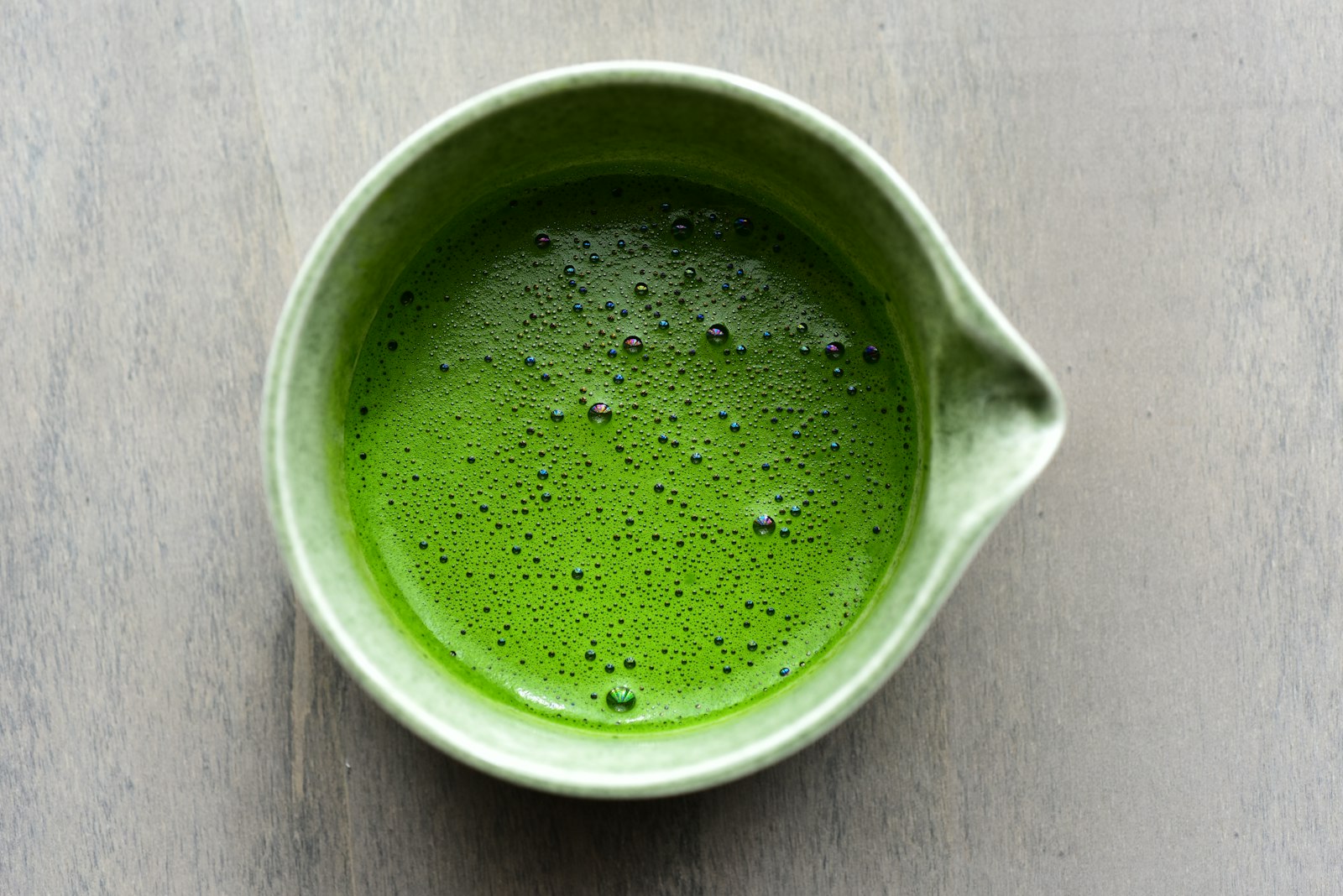
A bowl of matcha made with 2 g of powder has around 60 mg of caffeine, a little less than an espresso. According to studies, its L-theanine boosts the effect slightly at most.Caffeine per gram and per bowl, shade and quality, L-theanine studies and the EFSA values.
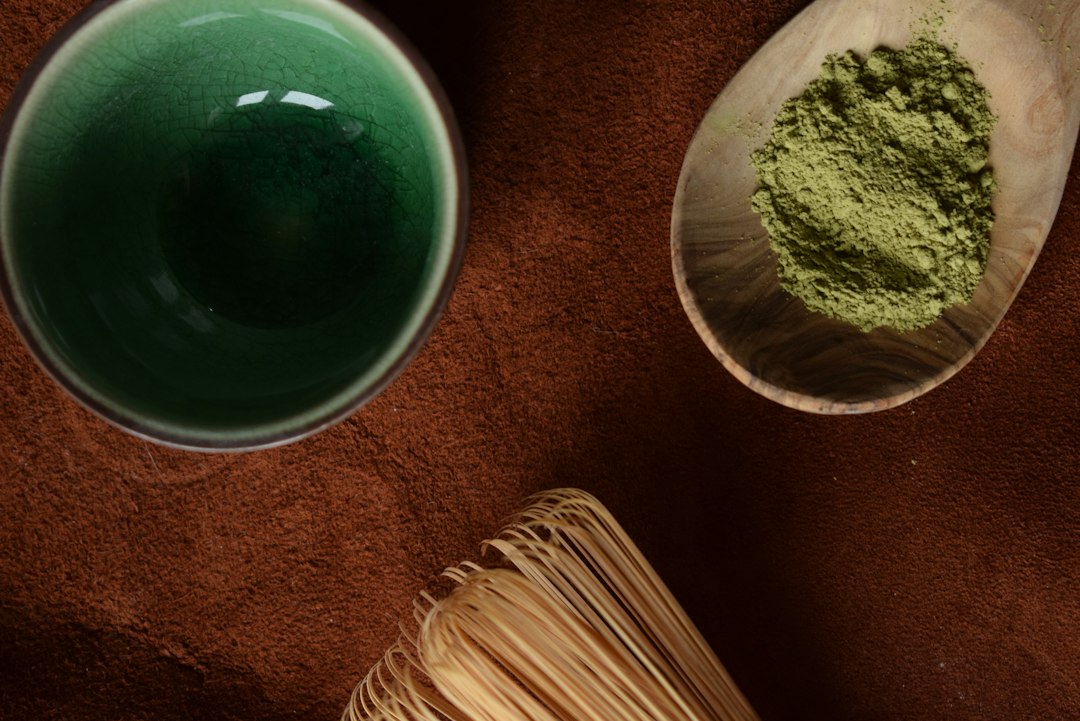
Matcha is ground green tea. Unlike with an infusion, you drink the whole leaf, and so all the caffeine in it too. How much ends up in your bowl depends on the powder’s content and the amount on the spoon.
Then there is L-theanine, an amino acid from the tea leaf. It gives shaded tea its umami, and advertising presents it as caffeine’s counterpart.
Caffeine per gram: 32 mg on average, with a wide range
The Japanese food composition table (MEXT) lists 3.2 g of caffeine per 100 g of matcha powder. That is 32 mg per gram.
This is an average with a wide spread. In 2023 a US research group analysed ten shop-bought matchas, five sold as ceremonial grade and five as culinary grade. Other studies found similar values, with one outlier at the low end.
| Study | Samples | Caffeine per gram of powder |
|---|---|---|
| Japanese food composition table (MEXT, 2023) | average value | 32 mg |
| Meyer et al., USA 2023, culinary grade | 5 matchas | 17.7 to 33.5 mg, average 26.3 mg |
| Meyer et al., USA 2023, ceremonial grade | 5 matchas | 25.0 to 35.0 mg, average 31.5 mg |
| Koláčková et al., Czech Republic 2020 | several matchas | 14.4 to 34.1 mg |
| Kika et al., Poland 2024 | 1 organic matcha from Uji, 2nd and 3rd harvest | around 2.2 mg |
Most measurements therefore fall between about 15 and 35 mg per gram. The US researchers suspect that ceremonial grade comes from the youngest leaves. Earlier studies found that young leaves contain more caffeine than older ones. They did not test this, and the differences between individual products were not statistically significant.
Caffeine per bowl: usucha, koicha and coffee compared
For the amount in the bowl, the recipe is what counts. A tea house in Kyoto gives 2 g of powder to 60 ml of water at 80°C for usucha, the thin matcha. That is about one level teaspoon. For koicha, the thick tea of the tea ceremony, it uses 4 g to just 30 ml.
| Drink | Amount | Caffeine at MEXT average | Range from the studies (our conversion) |
|---|---|---|---|
| usucha | 2 g powder, 60 ml water | around 64 mg | around 29 to 70 mg |
| koicha | 4 g powder, 30 ml water | around 128 mg | around 58 to 140 mg |
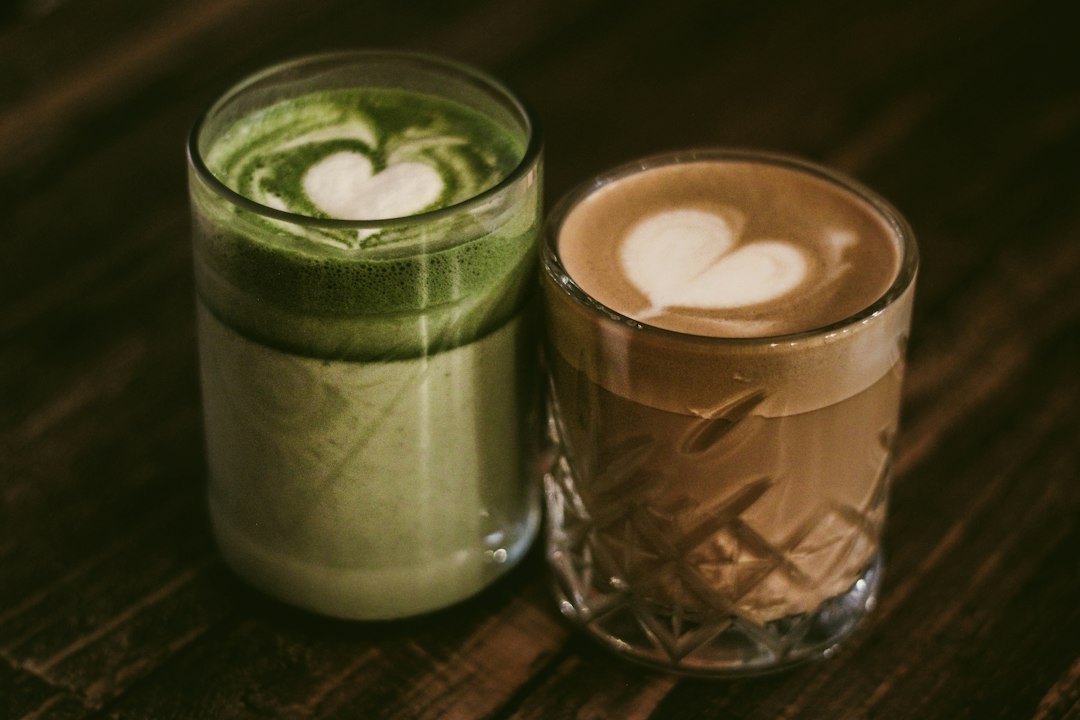
For comparison, Germany’s Federal Institute for Risk Assessment (BfR) puts an espresso at around 80 mg. Usucha is usually a little below that, while koicha can be well above it. A matcha latte with more powder has correspondingly more, and milk does not change that. More guide values and café measurements are in caffeine in espresso, filter coffee and cold brew.
Shade growing: more L-theanine, but not less caffeine
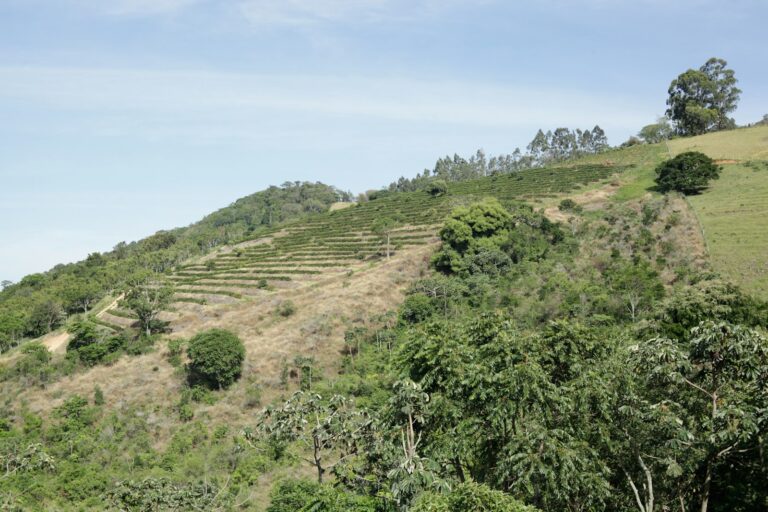
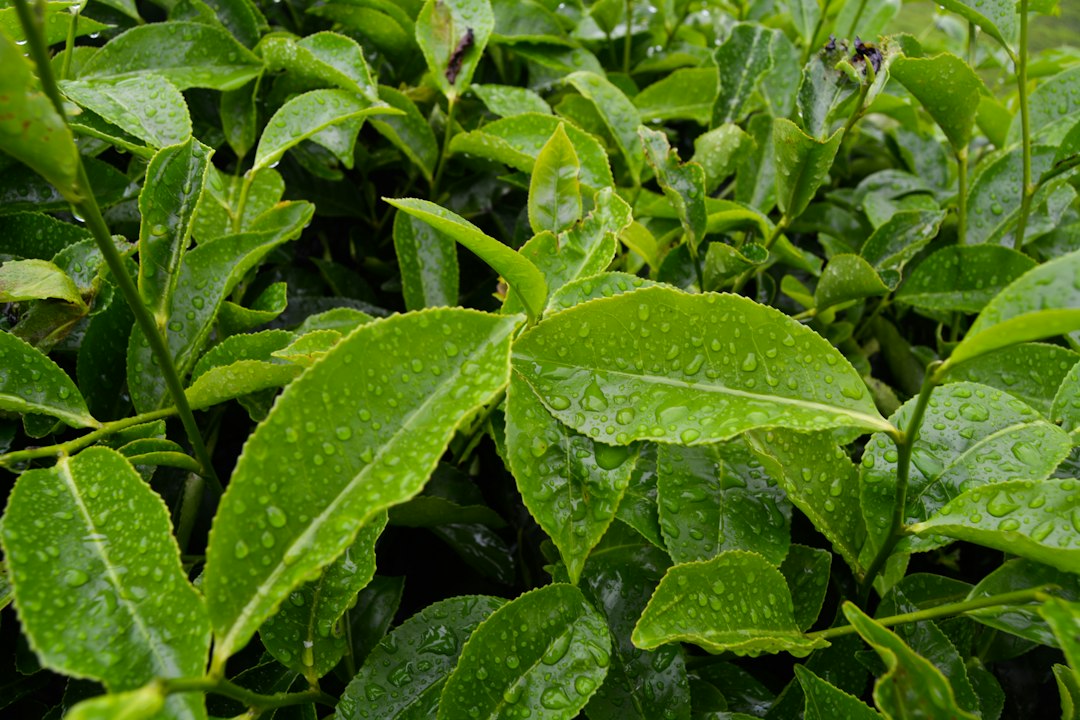
Matcha is ground from tencha. Before the harvest, the bushes are kept in shade for at least 20 days, similar to gyokuro. According to a handbook from NARO, Japan’s agricultural research institute, theanine and chlorophyll rise while the astringent catechins fall. How gyokuro and kabuse sencha are shaded is covered in how to brew gyokuro.
A 2025 review explains why. The tea bush produces L-theanine mainly in its roots and sends it to the young shoots. There, light breaks it down, and some of it is converted into catechins. Less light therefore means more theanine in the leaf.
Shade does not help with caffeine. In a 2022 Chinese study, a matcha tea garden was shaded at 85 and 95 per cent for three weeks. Theanine and chlorophyll rose, and caffeine even increased. However, only one cultivar at one site was tested. To taste tea grown in full sun, try sencha, which is more astringent and grassier: see sencha, Japan’s everyday green tea.
Ceremonial and culinary grade: what is in the powder
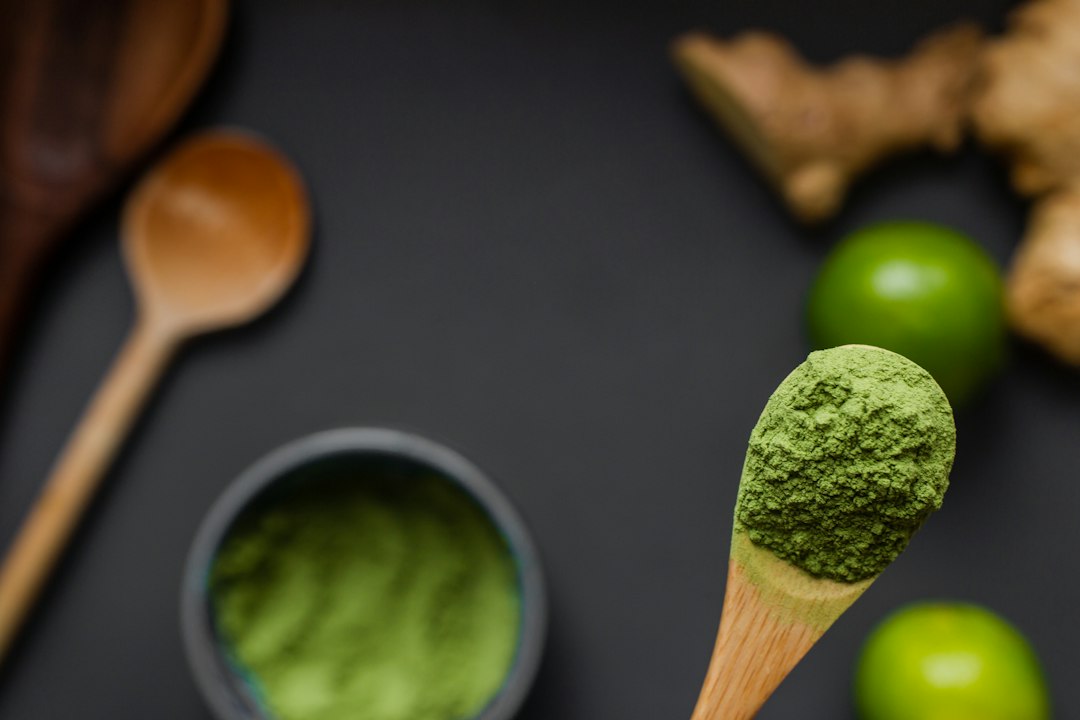
In shops, matcha is often sold as ceremonial or culinary grade. There are no fixed rules behind these terms. A Japanese tea retailer writes that Japan has no official or regulated grading system for matcha. Ceremonial grade is meant to taste good on its own with water. Culinary grade is intended for lattes and baking, and it is cheaper.
Price shows clearly in the L-theanine. In 2018 a Japanese research group analysed matcha sold in US shops. Powders costing more than 50 US dollars per 100 g contained over 15 mg of theanine per gram. Powders under 25 US dollars were below 7 mg. That is roughly €45 and €22 per 100 g (our conversion). One expensive organic ceremonial matcha did not fit the pattern, however.
| Powder | L-theanine per gram | per 2 g bowl (our conversion) |
|---|---|---|
| over 50 US dollars per 100 g (Horie et al. 2018) | over 15 mg | over 30 mg |
| under 25 US dollars per 100 g (Horie et al. 2018) | under 7 mg | under 14 mg |
| sample no. 1 from Unno et al. 2018 | around 29 mg | around 58 mg |
In 2018 a group led by Keiko Unno tested many shop-bought powders. 50 of 76 Japanese samples reached more than 17 mg of theanine per gram, but only 6 of 67 samples from other countries did. So for theanine, origin makes a big difference.
L-theanine plus caffeine: what studies show and where they stop
The combination of the two substances is the best studied, usually as a capsule or test drink. A 2014 meta-analysis evaluated eleven placebo-controlled studies. In the first two hours it found moderate effects on alertness and on accurate switching between tasks. The effects tended to depend more on caffeine than on theanine.
One example is a study from a tea company’s research division. 29 participants received an iced tea drink with 97 mg of L-theanine and 40 mg of caffeine. Afterwards they switched between tasks more accurately, but they did not feel more alert. This test drink contained more than twice as much theanine as caffeine. In a bowl of usucha it is usually the other way round. Based on the values above, around 64 mg of caffeine meets about 14 to 58 mg of theanine, depending on the powder.
There are few trials on matcha itself. In the Netherlands, 23 volunteers were given 4 g of matcha as a drink or a snack bar. An hour later they did slightly better at simple attention tasks and in reaction speed, while their mood did not change. The study was small and only single-blinded. In Japan, 39 pharmacy students drank 3 g of matcha a day for 15 days. With theanine-rich powder they reported less anxiety before a work placement. By the eighth day of the placement, the difference was no longer significant.
According to a 2025 review, slight benefits for alertness and focus are possible, mainly in combination with caffeine. But the studies are small and inconsistent, and large comparative studies are lacking. In 2011 EFSA examined advertising claims for L-theanine from tea, for example on concentration, stress and sleep. It did not consider a cause-and-effect relationship established for any of them.
How much a day: the EFSA values apply to matcha too
Caffeine from matcha counts like any other caffeine. The European Food Safety Authority (EFSA) considers up to 200 mg at once safe for healthy adults. Spread over the day, the figure is up to 400 mg. For pregnant and breastfeeding women it gives up to 200 mg a day.
A bowl of usucha therefore stays well below the single dose. Three bowls reach around 190 mg at the average value, and a strong bowl of koicha up to 140 mg (our conversion). Add coffee or generously dosed matcha lattes, and you quickly reach the daily amount.
As a rule of thumb, a level teaspoon of matcha brings a little less caffeine than an espresso. How much L-theanine comes with it depends on quality and origin.
Last updated: 24 October 2026.
Sources
- MEXT, Standard Tables of Food Composition in Japan (8th edition, 2023 supplement), via calorie.slism.jp: 抹茶 (matcha, powder) (in Japanese), accessed 24 October 2026.
- Meyer, B. R.; White, H. M.; McCormack, J. D.; Niemeyer, E. D., Plant Foods for Human Nutrition 78(4): Catechin Composition, Phenolic Content, and Antioxidant Properties of Commercially-Available Bagged, Gunpowder, and Matcha Green Teas, 3 November 2023.
- Kika, J. et al., Foods 13(8):1167, with values from Koláčková et al. 2020: Matcha Green Tea: Chemical Composition, Phenolic Acids, Caffeine and Fatty Acid Profile, 11 April 2024.
- Ippodo Tea (retailer information): Ummon-no-mukashi, preparation, accessed 24 October 2026.
- Bundesinstitut für Risikobewertung (BfR): Fragen und Antworten zu Koffein und koffeinhaltigen Lebensmitteln, einschließlich Energy Drinks (in German), as of 5 January 2026.
- NARO, research consortium project 27015C: 被覆茶安定生産マニュアル (handbook on producing shaded teas) (in Japanese), March 2018.
- Wang, Q.; Li, X. et al., Plants 14(3):492: L-Theanine Metabolism in Tea Plants: Biological Functions and Stress Tolerance Mechanisms, 6 February 2025.
- Chen, X. et al., Int. J. Mol. Sci. 23(22):14169: Effect of Shading on the Morphological, Physiological, and Biochemical Characteristics as Well as the Transcriptome of Matcha Green Tea, 16 November 2022.
- Ikkyu Tea, Bloise Aldo (retailer information): Ceremonial vs. Culinary Matcha: Why ‘Ceremonial Grade’ Isn’t a Japanese Classification, 5 November 2025.
- Horie, H.; Ema, K.; Nishikawa, H.; Nakamura, Y., JARQ 52(2): Comparison of the Chemical Components of Powdered Green Tea Sold in the US, 2018.
- Unno, K. et al., Nutrients 10(10):1468: Stress-Reducing Function of Matcha Green Tea in Animal Experiments and Clinical Trials, 10 October 2018.
- Camfield, D. A.; Stough, C.; Farrimond, J.; Scholey, A. B., Nutrition Reviews 72(8): Acute effects of tea constituents L-theanine, caffeine, and epigallocatechin gallate on cognitive function and mood: a systematic review and meta-analysis, 1 August 2014.
- NutraIngredients, on Einöther, S. J. L. et al., Appetite 54: Tea compounds may boost attention span: Unilever, 19 January 2010.
- Dietz, C.; Dekker, M.; Piqueras-Fiszman, B., Food Research International 99: An intervention study on the effect of matcha tea, in drink and snack bar formats, on mood and cognitive performance, 2017.
- Vitafoods Insights, on Dashwood and Visioli, Nutrition Research 2025: L-theanine: Does the science match up to the hype?, 2 July 2025.
- EFSA Panel on Dietetic Products, Nutrition and Allergies, EFSA Journal 9(6):2238: Scientific Opinion on the substantiation of health claims related to L-theanine from Camellia sinensis (L.) Kuntze (tea), 2011.
- European Food Safety Authority (EFSA): Caffeine (topic page on the opinion of 27 May 2015), accessed 24 October 2026.