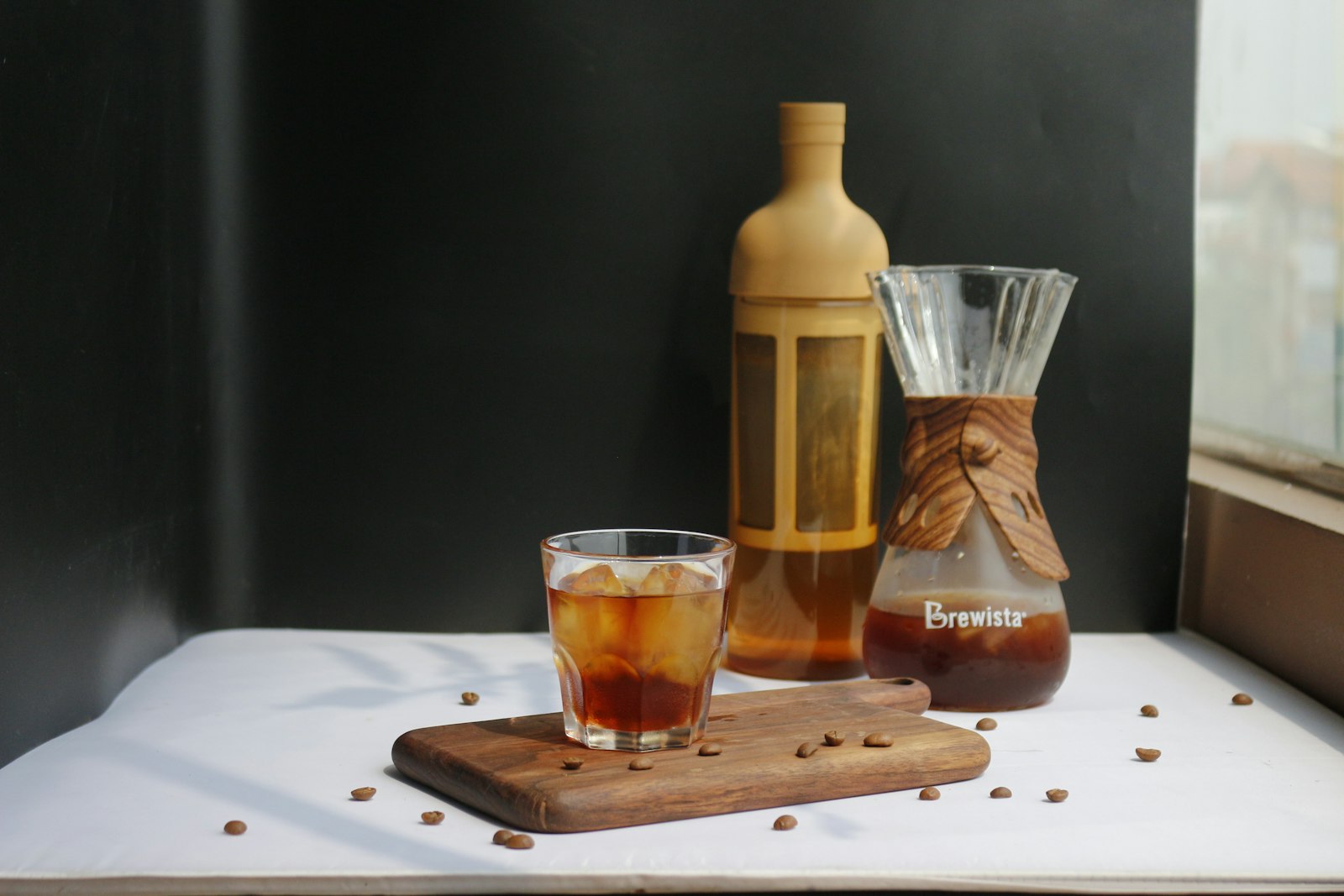
Steep 100 g of coarsely ground coffee in 1 litre of cold water in the fridge for 12 to 16 hours, then filter it. If you make it stronger as a concentrate, dilute it before drinking.Recipes for concentrate and ready-to-drink, a step-by-step guide, shelf life and cold brew compared with iced coffee.
Cold brew never comes into contact with hot water. Food chemists in Karlsruhe define it by temperature. The water stays below body temperature, typically around 8°C in the fridge or room temperature. Cold water dissolves flavours more slowly, so the brew needs many hours instead of a few minutes.
The work itself only takes a few minutes. You need coffee, cold water, a large jar or a French press (cafetière) and a paper filter. The fridge does the rest overnight.
The basic recipe: ratio, grind size and brew time
There is no fixed standard recipe, but the sources are close to each other. A Swiss roastery gives 100 g of coffee to 1 litre of cold, soft water as its basic recipe. For ready-to-drink cold brew it uses ratios of 1:10 to 1:13, and from 1:8 it becomes a concentrate. The grind is coarse, as for a French press, and the brew time is 12 to 16 hours, 24 hours at most.
Some systems make their concentrates much stronger. The instructions for a US cold brew system give 340 g of coarsely ground coffee to 1.65 litres of water and 12 to 24 hours. That is around 1:5 (our conversion). For a cold drink, dilute this concentrate about 1:1 with water, milk or ice. For hot coffee, add one to two times the amount of hot water.
| Version | Coffee : water | Grind size | Brew time | Afterwards |
|---|---|---|---|---|
| ready-to-drink (Swiss roastery) | 1:10 to 1:13, e.g. 100 g to 1 l | coarse | 12 to 16 h, 24 h at most | straight over ice |
| concentrate (Swiss roastery) | 1:8 or stronger | coarse | 12 to 16 h | top up with water, milk or tonic |
| concentrate (US cold brew system) | 340 g to 1.65 l, around 1:5 | coarse, like coarse sugar | 12 to 24 h | dilute 1:1 |
| cold brew jug (brewing guide from a US retailer) | 80 g to 1 l | medium | 12 to 18 h in the fridge | straight |
| survey of professionals (Karlsruhe 2020) | mostly 80 to 100 g per litre | coarse | 16 h on average | not stated |
The brew time depends on grind size and temperature. According to the roastery, cold brew made in the fridge turns out clearer and more controlled, while at room temperature it extracts a little faster. The Karlsruhe group itself works with 80 g per litre, ground medium-fine, and only around 2 hours at 15°C. Longer times added nothing to the taste and, above all, brought more bitterness.
A study from Philadelphia shows why the times can vary so much. Caffeine and chlorogenic acid were largely dissolved after 6 to 7 hours, and only a little was added after that. How much caffeine ends up in your glass therefore depends mainly on the ratio and the dilution. The figures are in caffeine in espresso, filter coffee and cold brew.
Step by step: mix, steep, filter
For one litre of ready-to-drink cold brew, a large jar with a lid or a French press is enough. Rinse the container, sieve and bottle with hot water first. Cold brewing lacks the heat that kills germs, so clean equipment matters more than with filter coffee.
- Grind: Grind 100 g of coffee coarsely, roughly as for a French press. Grounds that are too fine will clog the filter later.
- Mix: Put the grounds in the container, pour in 1 litre of cold water and stir once until everything is wet.
- Steep: Cover the container and put it in the fridge for 12 to 16 hours. Taste it once halfway through.
- Coarse separation: Press the plunger of the French press down slowly or pour everything through a fine sieve.
- Fine filtering: Then pour the coffee through a paper filter, for example in a pour-over dripper. This makes it clearer.
- Bottling: Pour the cold brew into a clean bottle that seals and put it straight back in the fridge.
The roastery uses the same two stages for its large batches. First comes a coarse pre-filter, then filter paper. The paper runs slowly, but it holds back fine particles that would otherwise cloud the coffee.
How to get a well-rounded cold brew:
- Start with 100 g of coffee to 1 litre of water, then change only one value at a time.
- If it tastes thin, use more coffee next time or let it steep longer.
- If it tastes woody or bitter, shorten the brew time or grind a little coarser.
- Use soft water, and stretch hard tap water with distilled water.
- Write the amount, grind size and hours on the lid so you can compare batches.
Beans and water: what tastes good as cold brew
Cold water brings out different sides of a coffee than hot water. The Swiss roastery recommends medium roasts with notes of chocolate, nuts and caramel. In its experience, light, fruity filter coffees suit coffee brewed hot over ice better. In the Karlsruhe survey, respondents also preferred medium roasts with a coarse grind.
This is a matter of taste and not a fixed rule. Feel free to try a fruity washed coffee cold as well, as it usually tastes softer than hot. How light, medium and dark roasts differ is explained in light, medium and dark roasts.
Because cold brew is almost entirely water, you taste its hardness too. The roastery advises cold, soft water, and the Karlsruhe group brewed with 4.8 °dH (German degrees of hardness, about 86 mg/l calcium carbonate, our conversion). How to assess your tap water and soften hard water is shown in which water for coffee.
Acidity in cold brew: a similar pH, less acid overall
Cold brew is said to be especially low in acid. Researchers at Thomas Jefferson University in Philadelphia tested this in 2018. They brewed six light to medium roasts from several countries once hot and once cold. For the cold brew, 35 g of coffee steeped in 350 ml of water for 7 hours at room temperature.
| Measurement | Cold brew | Hot brewed |
|---|---|---|
| pH | 4.96 to 5.13 | 4.85 to 5.10 |
| titratable acidity | lower | higher |
| antioxidant capacity | lower | higher |
The pH was almost the same for both brewing methods. However, hot brewed coffee contained more titratable acidity, meaning more acid overall. The researchers therefore consider pH a poor measure of the acidity in coffee. If cold brew tastes softer to many people, that is more likely down to the mix of dissolved substances.
The study has its limits. Only six coffees were tested, and filtration did not take place at a controlled temperature. It did not measure any health effects. So it offers no promise for sensitive stomachs.
Cold brew or iced coffee: two routes to cold coffee
Iced coffee is coffee brewed hot and then cooled. In the Japanese method, also called flash brew, ice in the carafe replaces part of the brewing water. The Swiss roastery gives 30 g of coffee, 150 g of hot water and 150 g of ice, brewed as a pour-over. How to pour for this is explained in V60, Kalita and Chemex pour-over.
| Cold brew | Japanese iced coffee (flash brew) | |
|---|---|---|
| Water | cold, around 8°C up to room temperature | hot, half of it replaced by ice |
| Time | 12 to 16 hours | a few minutes |
| Example recipe | 100 g to 1 l | 30 g, 150 g water, 150 g ice |
| Taste | soft, chocolatey | clearer and fruitier |
| Suitable beans | medium roasts | light, fruity filter coffees |
| In the fridge | a few days | keeps for less time |
There is also a middle way. The roastery’s founder pours a third of the water on hot and tops up the other two thirds cold. The brew then goes into the fridge for 8 hours. None of the three versions has much to do with German Eiskaffee, which is coffee with vanilla ice cream and whipped cream.
Shelf life: a few days in the fridge
Cold brewing lacks the step that kills germs. On top of that, according to the Karlsruhe review, the pH of cold brew is usually between 4.9 and 6.0. Only below 4.6 does the acidity reliably slow germs down. According to a study cited there, salmonella, listeria and E. coli can survive in cold brew for 7 to 28 days.
The picture for shop-bought cold brew is reassuring. The Canadian Food Inspection Agency tested 59 packaged, chilled cold brews. It found salmonella and E. coli O157 in none of the samples. In 15 samples the total bacterial count was raised, which the agency sees as a sign of gaps in hygiene.
| Source | Recommendation |
|---|---|
| Swiss roastery, ready-to-drink | usually 2 to 3 days |
| Swiss roastery, concentrate | 5 to 7 days, depending on the method |
| Karlsruhe review, small producers | 2 days at most, ideally fresh every day |
| Maricopa County health department (USA), for businesses | 7 days at most at no more than 5°C |
| Instructions for a US cold brew system, concentrate | up to 2 weeks |
There is no official time limit for homemade cold brew in Germany. The Bundesinstitut für Risikobewertung (Germany’s Federal Institute for Risk Assessment, BfR) recommends a fridge temperature of 7°C at most, ideally below 5°C. According to the BfR, chilled leftovers should be eaten within two to three days. For ready-to-drink cold brew, that is a cautious guideline that matches the roastery’s advice.
If the coffee smells fermented or sour, turns cloudy or shows mould, pour it away. The roastery explicitly advises relying on your nose and eyes rather than the number of days. Small batches that you drink within two to three days are the simplest solution.
To start with, a jar, a sieve and a paper filter are enough. In the evening, mix 100 g of coarsely ground coffee with 1 litre of cold water and filter it the next morning. Then adjust the amount and time to your taste.
Last updated: 24 October 2026.
Sources
- Benjamin Hohlmann, Kaffeemacher: Cold Brew (in German), 4 July 2026.
- Kwok, R.; Lee Wee Ting, K.; Schwarz, S.; Claassen, L.; Lachenmeier, D. W., Challenges 11(2), 26: Current Challenges of Cold Brew Coffee: Roasting, Extraction, Flavor Profile, Contamination, and Food Safety, 13 October 2020.
- Rao, N. Z.; Fuller, M., Scientific Reports 8, 16030: Acidity and Antioxidant Activity of Cold Brew Coffee, 30 October 2018.
- Fuller, M.; Rao, N. Z., Scientific Reports 7, 17979: The Effect of Time, Roasting Temperature, and Grind Size on Caffeine and Chlorogenic Acid Concentrations in Cold Brew Coffee, 21 December 2017.
- Seattle Coffee Gear: Toddy Cold Brew System Product Guide, undated, accessed 24 October 2026.
- Ragan LaTour-Kelley, Prima Coffee: Hario Mizudashi Brewing Guide, 14 July 2023.
- Canadian Food Inspection Agency: Bacterial Pathogens in Cold Brewed Coffee, April 1, 2018 to March 31, 2019, 2020.
- Maricopa County Environmental Services: Cold Brew Coffee Guidance, March 2024.
- Bundesinstitut für Risikobewertung (BfR): Fragen und Antworten zum korrekten Kühlen von Lebensmitteln im Privathaushalt (in German), 13 February 2023.