Since 2008, Chinese origin rules limit genuine pu-erh to Yunnan: large-leaf, sun-dried tea, either aged slowly as sheng or fermented quickly as shou.Sheng and shou, the 357 g cake, storage and gaiwan brewing, and signs of fakes.
Pu-erh is the tea that is supposed to get better with age. It is often pressed into cakes, stored for years and infused again and again in small amounts. That sounds like a science for insiders, but it is easier than it looks. With a knife, a small teapot or a gaiwan and boiling water, you can already go a long way.
What pu-erh is: large-leaf tea with a protected origin
Pu-erh is made from the large-leaf Yunnan variety of the tea plant, Camellia sinensis var. assamica. In China, pu-erh has been a product with a geographical indication since 2008. The corresponding standard, GB/T 22111-2008, has applied since 1 December 2008.
The specification is also filed in the EU register of geographical indications. It describes pu-erh as tea made from large-leaf, sun-dried Yunnan tea. The growing area covers parts of 11 prefectures in Yunnan, including Pu’er, Xishuangbanna and Lincang. The gardens lie at 1,000 to 2,100 metres. According to these rules, tea from other provinces may not be sold as pu-erh.
Sheng and shou: natural ageing versus the 1973 method
Sheng, also called raw pu-erh, is steamed, pressed and dried after sun-drying. It then continues to age slowly over years. Young sheng often tastes fresh and astringent, and it grows rounder with age.
Shou, or ripe pu-erh, is a fairly recent invention. In 1973 the Kunming Tea Factory developed the wo dui method, a post-fermentation in damp piles. It shortens the ageing process considerably. Soon afterwards the Menghai Tea Factory adopted the method, and mass production began in 1975. Shou tastes earthy, smooth and dark, without years of storage.
| Sheng (raw) | Shou (ripe) | |
|---|---|---|
| Processing | sun-dried, steamed, pressed | additionally post-fermented (wo dui) |
| Ageing | slowly over years | accelerated, ready to drink |
| Flavour | fresh and astringent when young, rounder when old | earthy, smooth, dark |
| Rinsing before brewing | once, around 20 seconds | twice, around 15 seconds each |
The flavour descriptions in the table are rough guidelines, and individual teas vary. If you are curious about how other partly or fully oxidised teas are processed, read our guide to oolong.
Bing, tuo and bricks: formats and how to store them
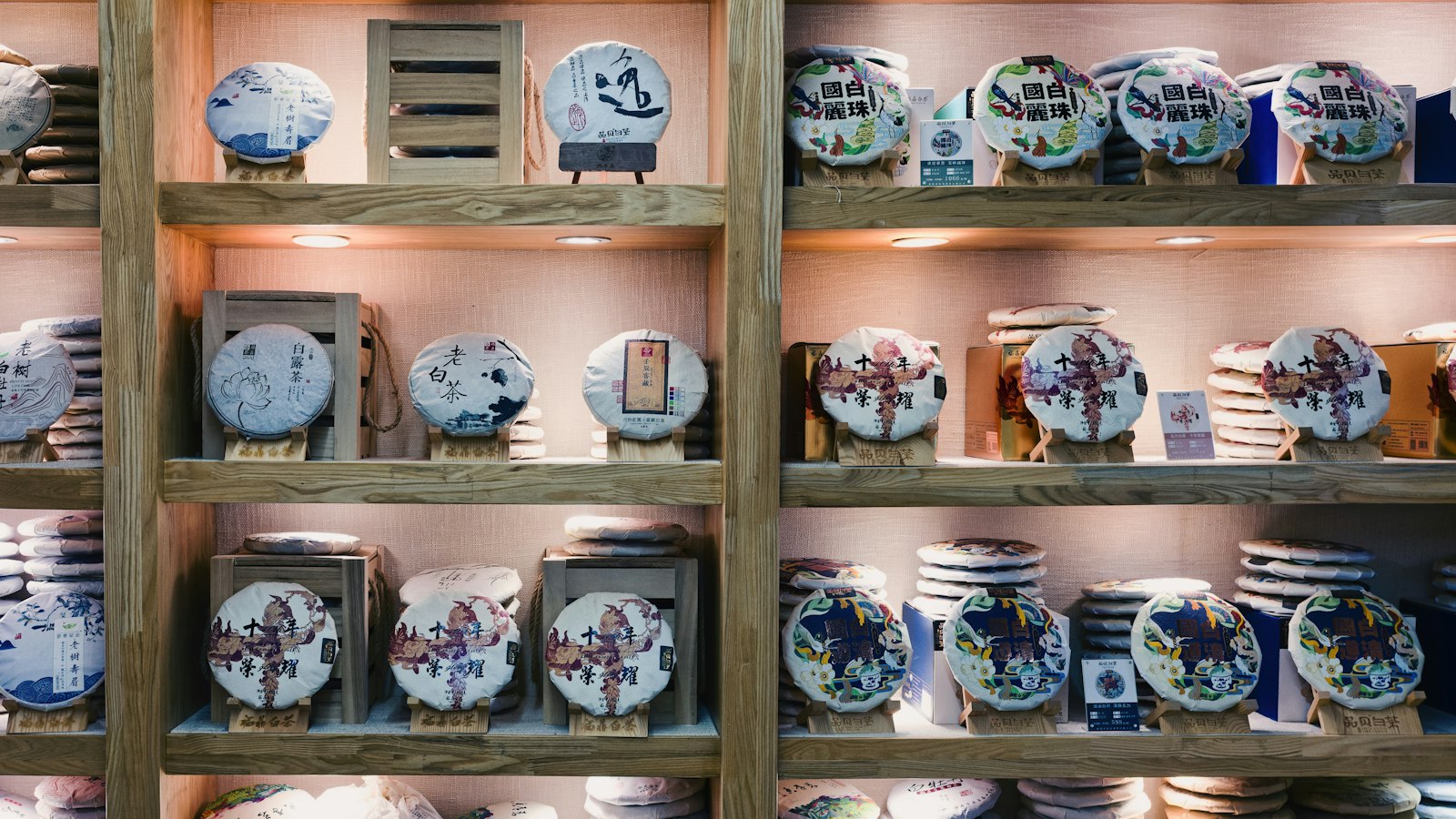
The best-known pu-erh is the round cake, called a bing. It most often weighs 357, 400 or 500 g. There is also the bowl-shaped tuocha, usually 100, 250 or 500 g, and bricks from 100 to 1,000 g. Bricks used to be the usual form for transport by horse caravan.
For storage, humidity speeds up ageing. The recommendation is 60 to 85 per cent relative humidity, while strong heat harms the aroma. Tightly pressed formats age more slowly than loosely pressed ones. Vacuum-sealed in plastic, the ageing eventually stops. For everyday use, a cupboard free of odours, away from the hob and spices, is enough.
Brewing: gongfu in a gaiwan or Western style in a teapot
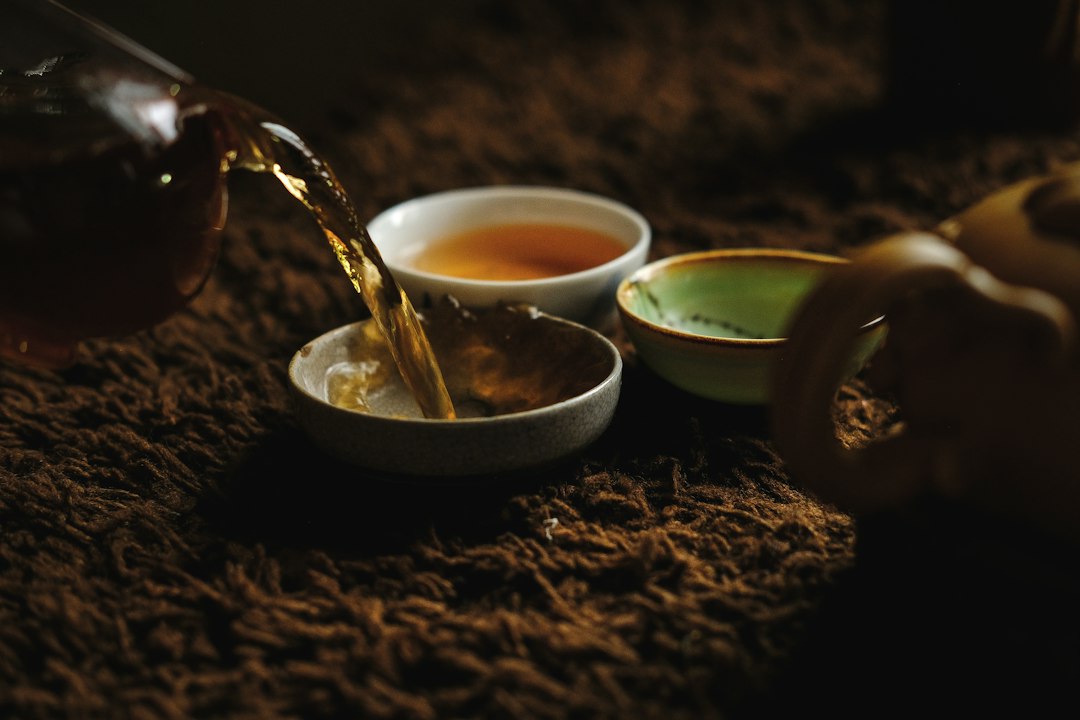
Pu-erh wants hot water: 95 to 100°C, ideally freshly boiled. For the Chinese gongfu method, use 5 to 7 g of tea per 100 ml. First rinse the leaves briefly and pour the water away. Then start with short infusions of 5 to 15 seconds. Lengthen the time with each further infusion. A good pu-erh can be infused 10 to 20 times this way.
Without a gaiwan, you can brew it Western style: 3 to 5 g per 250 ml and a steeping time of 2 to 4 minutes. Young sheng with small leaves needs less time than old sheng with large leaves. The basics of temperature and steeping time are in our guide how to brew tea properly.
| Method | Amount | Temperature | Steeping time |
|---|---|---|---|
| Gongfu (gaiwan, small teapot) | 5 to 7 g per 100 ml | 95 to 100°C | 5 to 15 s at first, then longer |
| Western (teapot, cup) | 3 to 5 g per 250 ml | 95 to 100°C | 2 to 4 min |
For your first pu-erh sessions:
- Start with shou: it forgives mistakes and does not need years of storage.
- Prise the cake apart with a knife from the edge rather than hacking from the top, so the leaves stay more intact.
- Rinse sheng once and shou twice, briefly, with boiling water.
- In a gaiwan, start with 6 g per 100 ml and around 10 seconds, then go gradually longer.
- If you use porous clay teapots, keep separate ones for shou and sheng.
Our recommendations
Teapot · around €28
Hario ChaCha Kyusu Maru 300 ml
Pros: Heat-resistant glass shows the colour of the liquor, the roomy strainer gives the leaves space, and the pot is dishwasher-safe.
Cons: For gongfu at 5 to 7 g per 100 ml, this pot needs 15 to 21 g of tea (our calculation). The strainer is made in China.
Pu-erh · around €9
Ronnefeldt Pu-Erh Bio lose 100 g
Pros: Loose leaf instead of a cake, so it is easy to measure without a knife; Ronnefeldt describes it as earthy with a red liquor, good for a Western teapot.
Cons: The product description does not say whether it is sheng or shou, or which vintage; loose tea rather than a pressed cake.
Prices, fakes and caffeine: what to look for when buying
Counterfeit pu-erh is widespread. Counterfeiters copy the packaging of well-known brands, including the pressed-in label (nei fei) and the inserted slip (nei piao). They claim an older age or a more famous mountain, or use tea from outside Yunnan. In 2021, police in Shanghai seized more than 10 tonnes of fake cakes. Their value was estimated at around 1.8 billion yuan.
From 2008, prices fell sharply after a boom, and many producers made losses. In European specialist shops, aged 357 g cakes from well-known factories cost around €50. Decades-old cakes at bargain prices are a warning sign. Buy from retailers who state the origin, vintage and factory.
Pu-erh is not a low-caffeine tea. A teahouse in Montreal had caffeine measured in a lab: 57 and 70 mg per cup for two shou, 52 mg for a sheng. For comparison, a matcha came to 93 mg. The figures come from a small sample, and the method is not described very clearly on the page. You can read more about tea from China in Chinese green tea.
Pu-erh rewards curiosity: one cake lasts for many sessions, and every infusion tastes a little different. Start with a good shou, take your time over a few short infusions and then work your way towards sheng. You’ll find more ideas for a quiet tea break in afternoon tea rituals.
All prices are guide prices and may change.
All product details are based on manufacturer and retailer information; we have not tested the products ourselves.
Last updated: 24 October 2026.
Sources
- Wikipedia: Pu’er tea, accessed 23 October 2026.
- chinesestandard.net: GB/T 22111-2008 Product of geographical indication – Puer tea, 17 June 2008.
- European Commission, eAmbrosia: Technische Spezifikation Pu’er Tea (in German), accessed 23 October 2026.
- Yunnan Sourcing: Brewing guide for green, black, oolong and pu-erh teas, accessed 23 October 2026.
- Teasenz: How Long to Steep Pu Erh Tea? A Complete Brewing Guide, accessed 23 October 2026.
- Tea & Coffee Trade Journal, J.W. Kaler: Fake cake: the business of counterfeit pu’er teas, 6 September 2023.
- Camellia Sinensis Teahouse: Analysis of caffeine, accessed 23 October 2026.
- Teasenz: 2017 Xiaguan FT7573 Ripe 357 g, accessed 23 October 2026.
- Teasenz: Chaze Da Hong Yin Ripe Pu Erh 357 g, accessed 23 October 2026.
- HARIO Global: ChaCha Kyusu „Maru“ Tea Pot, accessed 24 October 2026.
- Green Plantation: Hario Chacha Kyusu-Maru 300 ml Teekanne (in German), accessed 24 October 2026.
- Ronnefeldt: Pu-Erh (in German), accessed 24 October 2026.
- Teeshop Berlin: Ronnefeldt Pu-Erh Bio (in German), accessed 24 October 2026.
Our selection is editorial, there are no paid placements. Links marked * are affiliate links to Amazon Germany (amazon.de): if you buy through them, we receive a small commission at no extra cost to you. We have not tested the products ourselves; pros and cons are based on manufacturer information and retailer descriptions. Prices are guide prices from German shops as of October 2026, and price and availability on Amazon may differ.