Decaf roasted coffee in Germany may contain at most 0.1 per cent caffeine, and it is always removed from the green coffee, long before roasting.Four decaffeination methods from dichloromethane to CO2, the legal position, residual caffeine and clues on the pack.
Many people see decaf as a dull fallback for the evening. Behind it, though, lies an elaborate industrial process. Whether it uses solvents, water or carbon dioxide is rarely stated on the pack. We explain the methods and put the debate about dichloromethane into context.
From benzene to CO2: an invention from Bremen
The story of decaf begins in Bremen. In 1905 the coffee merchant Ludwig Roselius patented a process that dissolved caffeine out of the beans with benzene. A year later he founded Kaffee HAG. The first decaf on sale, however, contained traces of benzene, which is now considered carcinogenic.
By around 1970, dichloromethane and ethyl acetate had long since replaced benzene. At the same time, Kurt Zosel at the Max Planck Institute for Coal Research in Mülheim an der Ruhr made a rather accidental discovery. Caffeine dissolves in supercritical carbon dioxide. He applied for a patent on his process in 1970. According to the Max Planck Society, around 100,000 tonnes of green coffee a year are now decaffeinated with CO2 worldwide. Bremen is still a centre of the industry: CR3 Kaffeeveredelung and the Coffein Compagnie, for example, are based there.
Four methods, one goal: getting the caffeine out of the green bean
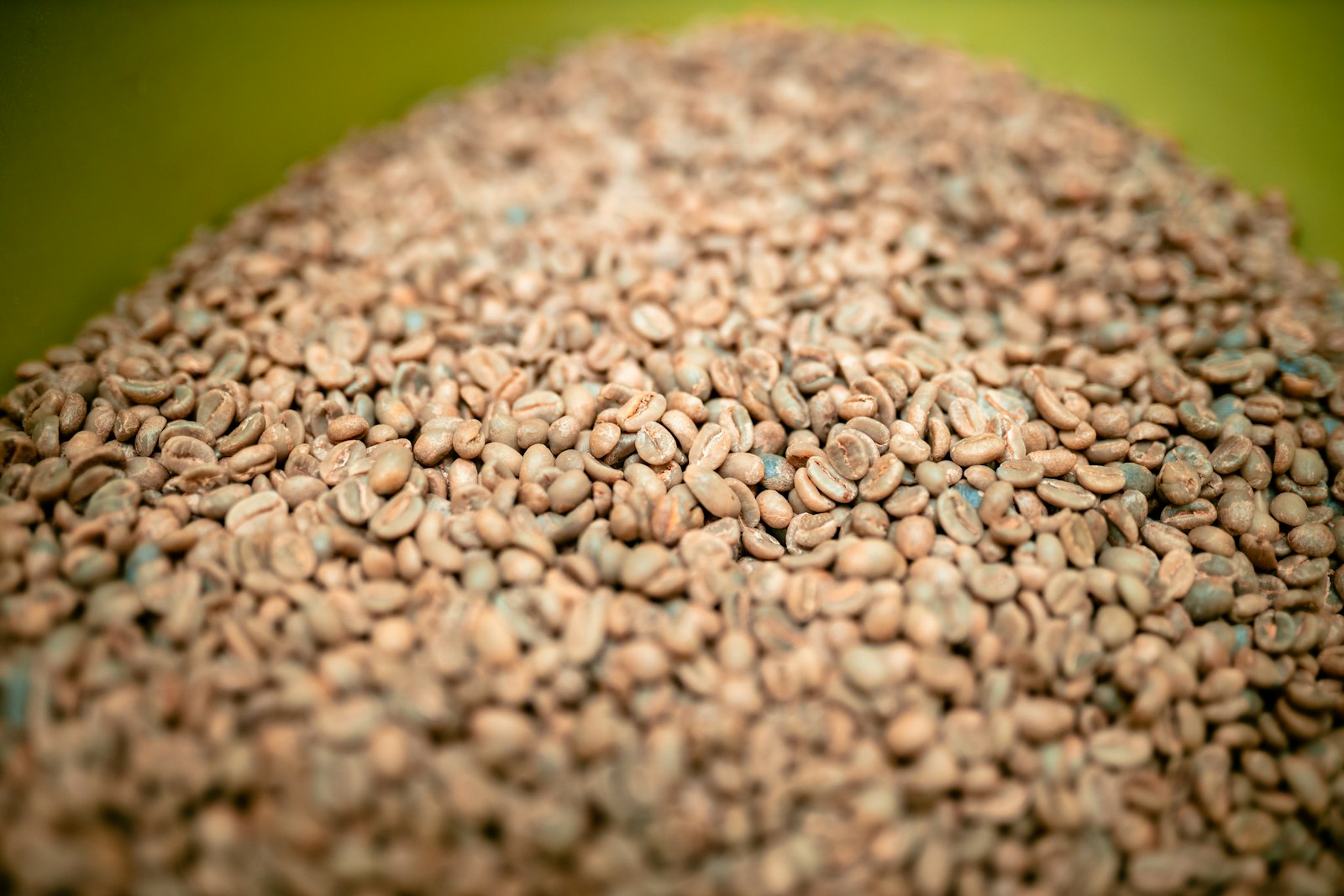
All methods follow the same basic pattern. The green coffee beans are steamed or soaked so that they swell. An extraction agent then draws out the caffeine. Residues are removed afterwards, and the beans are dried back to 10 to 12 per cent moisture. The difference lies in the agent and in temperature, pressure and duration.
| Method | How it works | Typical conditions | Clue on the pack |
|---|---|---|---|
| Dichloromethane (DCM) | Solvent binds the caffeine and is then evaporated off | at CR3 around 9 hours, 60 to 99°C, around 97 % of caffeine removed | usually none |
| Ethyl acetate | Solvent, often obtained from sugar cane | at the producer Descafecol, cycles of around 8 hours | ‘natürlich entkoffeiniert’ (naturally decaffeinated), ‘Sugar Cane’ |
| Swiss Water | Beans steep in a caffeine-free green coffee extract, the caffeine migrates out and is filtered | 8 to 10 hours, water only | ‘Swiss Water’ |
| Supercritical CO2 | Carbon dioxide under high pressure dissolves the caffeine | 250 to 300 bar, 60 to 80°C | ‘CO2-Verfahren’ (CO2 process) |
| Subcritical CO2 | liquid CO2 at a lower temperature | 70 to 80 bar, 23°C, 6 to 7 days, under 0.08 % residual caffeine | ‘CO2’, sometimes with an organic label |
Dichloromethane is the most common worldwide and is considered relatively selective. Ethyl acetate is often marketed as ‘natural’, because it also occurs in fruit and can be obtained from sugar cane. Chemically, though, it is the same molecule as synthetic ethyl acetate, so ‘natural’ only describes its origin. Swiss Water advertises ‘99.9 per cent caffeine-free’ and ‘100 per cent chemical-free’. These are manufacturer claims. The trade portal kaffeemacher.de found no independent primary source for the 99.9 per cent.
For a look at possible new approaches, see our news piece on decaffeination with nanofilters.
What the law allows: 0.1 and 0.3 per cent
In Germany, the Kaffeeverordnung (Germany’s Coffee Ordinance) sets out when a coffee may be called ‘entkoffeiniert’ (decaffeinated). For green and roasted coffee, the limit is 1 gram of caffeine per kilogram of dry matter, or 0.1 per cent. For coffee extract, meaning instant coffee, the maximum is 3 grams per kilogram, or 0.3 per cent. The terms ‘koffeinfrei’ (caffeine-free) and ‘Decaf’ are not provided for as legal product names. The prescribed word is ‘entkoffeiniert’.
The permitted solvents are set out in EU Directive 2009/32/EC. For dichloromethane, the maximum residue limit is 2 milligrams per kilogram of roasted coffee and 5 milligrams per kilogram of tea. For methyl acetate, it is 20 milligrams per kilogram. Ethyl acetate and carbon dioxide are approved without a specific maximum limit.
| Rule | Limit | Legal basis |
|---|---|---|
| Caffeine in decaffeinated roasted coffee | max. 1 g/kg dry matter (0.1 %) | Kaffeeverordnung § 2 |
| Caffeine in decaffeinated coffee extract | max. 3 g/kg dry matter (0.3 %) | Kaffeeverordnung § 2 |
| Dichloromethane residue in roasted coffee | max. 2 mg/kg | Directive 2009/32/EC |
| Methyl acetate residue in coffee | max. 20 mg/kg | Directive 2009/32/EC |
| Ethyl acetate, CO2 | approved without a specific maximum limit | Directive 2009/32/EC |
Dichloromethane under debate: what measurements show
The International Agency for Research on Cancer (IARC) classifies dichloromethane as ‘probably carcinogenic’ (Group 2A). What matters for your cup, though, is how much of it remains. A study of 34 decaffeinated coffees from supermarkets in six EU countries found an average of 0.127 milligrams per kilogram. The median was 0.059. Even the 5 per cent of samples with the highest levels, at 0.444 milligrams, were well below the EU limit of 2 milligrams.
The same study also shows, however, that part of the residue ends up in the drink. For filter coffee the median was around 27 per cent, for the French press (cafetière) around 43 per cent. The results were presented at a scientific conference in 2024. It is a conference paper with a limited sample.
In the USA, a petition from several environmental and health organisations has been pending since December 2023. It asks for dichloromethane and three other solvents to be removed from food approval. The US Food and Drug Administration (FDA) reopened the comment period in May 2026 and closed it at the end of June 2026. No decision had been announced by the end of July 2026. The US trade body National Coffee Association opposes a ban. In the EU, dichloromethane remains permitted with the limit mentioned above.
How much caffeine remains and how decaf tastes
‘Decaffeinated’ does not mean caffeine-free. A US study from 2006 measured 0 to 13.9 milligrams of caffeine per 473 millilitres in brewed decaf from coffee shops. In decaf espresso it found 3 to 15.8 milligrams per shot. The AOK, a German statutory health insurer, gives 1 to 5 milligrams for a 150-millilitre cup, compared with 60 to 180 milligrams for regular coffee. Our overview of the caffeine content of espresso, filter coffee and cold brew shows how much caffeine regular coffee drinks contain.
Along with the caffeine, other soluble substances leave the bean, such as acids, sugars and fats. The body changes most noticeably as a result. Less selective methods can leave a thinner coffee. Experts describe tendencies: a slightly soy-like note with dichloromethane, something malty with water methods, more acidity with ethyl acetate, a rather muted character with CO2. These are roasters’ observations, not study results. The quality of the green coffee remains the most important factor.
Recognising the method and buying well: label, price, choice
The method does not have to appear on the pack, and many supermarket brands leave it out. Specialty coffee roasters, on the other hand, usually name it because it affects the flavour. ‘Natürlich entkoffeiniert’ (naturally decaffeinated) usually points to ethyl acetate. If there is no clue at all, you can only find out the method by asking the producer. According to the AOK, organic decaf is assumed to use water or CO2 methods. If in doubt, it is worth asking.
Decaf usually costs more because it needs an extra industrial step, including transport to the decaffeinator and back. On top of that come high minimum quantities: around 2,500 kilograms at Descamex, around 3,000 kilograms at CR3 and 4,560 kilograms at Swiss Water. We found no reliable average figure for the price premium.
How to get more out of decaffeinated coffee:
- Look for terms such as ‘natürlich entkoffeiniert’, ‘CO2’ or ‘Swiss Water’. If nothing is stated, the method is unknown.
- If you want to avoid dichloromethane, choose roasters that state their method openly.
- Grind decaf slightly coarser and use a slightly higher dose than for your usual beans.
- Buy small packs and look for a recent roast date.
- Expect 2 to 15 milligrams of caffeine per cup, even if the pack says ‘decaffeinated’.
Decaffeinated coffee is better than its reputation, provided the green coffee is good and the method is transparent. The law strictly limits caffeine and solvent residues. Choosing a method remains a matter of taste and trust.
Last updated: 24 October 2026.
Sources
- Max-Planck-Gesellschaft: Kaffee auf Entzug (in German), 12 August 2014.
- kaffeemacher.de: Entkoffeinierung: Verfahren im Überblick (in German), 1 September 2026.
- kaffeemacher.de: Entkoffeinierter Kaffee (in German), 26 August 2026.
- Swiss Water Decaffeinated Coffee: The Swiss Water Process, 13 November 2025.
- Bundesamt für Justiz: Kaffeeverordnung (KaffeeV), § 2 (in German), last amended 5 July 2017.
- gesetze.legal: Richtlinie 2009/32/EG, Anhang I (in German), accessed 23 October 2026.
- Fabian et al., sciforum: Mass Transfer of Dichloromethane from EU Retail Roast and Ground Decaffeinated Coffee into Prepared Beverages, 14 October 2024.
- FoodNavigator: Activists petition to remove methylene chloride, 25 March 2024.
- Daily Coffee News: FDA weighs next steps on decaf solvent rules, 30 June 2026.
- Barista Magazine: Will the FDA Ban Methylene Chloride in Decaf Coffee?, 27 July 2026.
- McCusker et al., PubMed: Caffeine content of decaffeinated coffee, 2006.
- AOK: Darum solltest du bei entkoffeiniertem Kaffee aufpassen (in German), updated 14 August 2025.
- Coffee Circle: Decaf Coffee, accessed 23 October 2026.
- Coffee Circle: Buna Dimaa Decaf, price accessed 23 October 2026.
- Martermühle: Bio Kaffee Mexiko entkoffeiniert (in German), price accessed 24 October 2026.
- Martermühle: Bio Espresso Mexiko entkoffeiniert (in German), price accessed 24 October 2026.
Image credits
- Steaming cup of black coffee, black-and-white photo – Photo: Steve Harvey / Unsplash