Oolong is a partly oxidised tea between green and black tea. Depending on oxidation and roasting, it tastes floral and light or dark and toasty.Production, well-known teas from China and Taiwan, flavour and brewing in a teapot and gaiwan.
Green tea, oolong and black tea all come from the same plant, Camellia sinensis. The difference lies in how the leaf is processed after picking. With green tea, heat stops the leaf’s own enzymes straight away. With black tea they work almost to the end, while with oolong the tea maker stops them halfway.
In China and Taiwan oolong is often called semi-fermented. This does not mean fermentation by yeasts or bacteria, but oxidation. As soon as the leaf cells are damaged, enzymes change the tea’s astringent catechins. The further this goes, the darker and fruitier the leaf becomes.
Oxidation: from just over 10 to 70 per cent
The tea maker decides how far an oolong oxidises. In 2020 a Taiwanese research group ranked the island’s well-known specialty teas by their degree of oxidation. Green tea sits at 0 per cent, a Taiwanese black tea at over 90 per cent.
| Tea | Origin in Taiwan | Oxidation | Shape of the dry leaf |
|---|---|---|---|
| Wenshan Pouchong | New Taipei | 12 to 15 % | twisted, green |
| High mountain oolong | Chiayi County | 20 to 30 % | semi-ball, green |
| Dong Ding | Nantou County | 20 to 30 % | semi-ball, green |
| Tieguanyin from Taiwan | Taipei | 30 to 40 % | ball-shaped, dark green |
| Oriental Beauty (Baihao) | Hsinchu County | 60 to 70 % | ball-shaped, multicoloured |
Individual lots can differ, and teas from Fujian are not included in the study. Still, the range shows why the word oolong on its own says little about flavour. A Pouchong is close to green tea, while an Oriental Beauty is closer to black tea.
Production: withering, tossing, heating, rolling, roasting
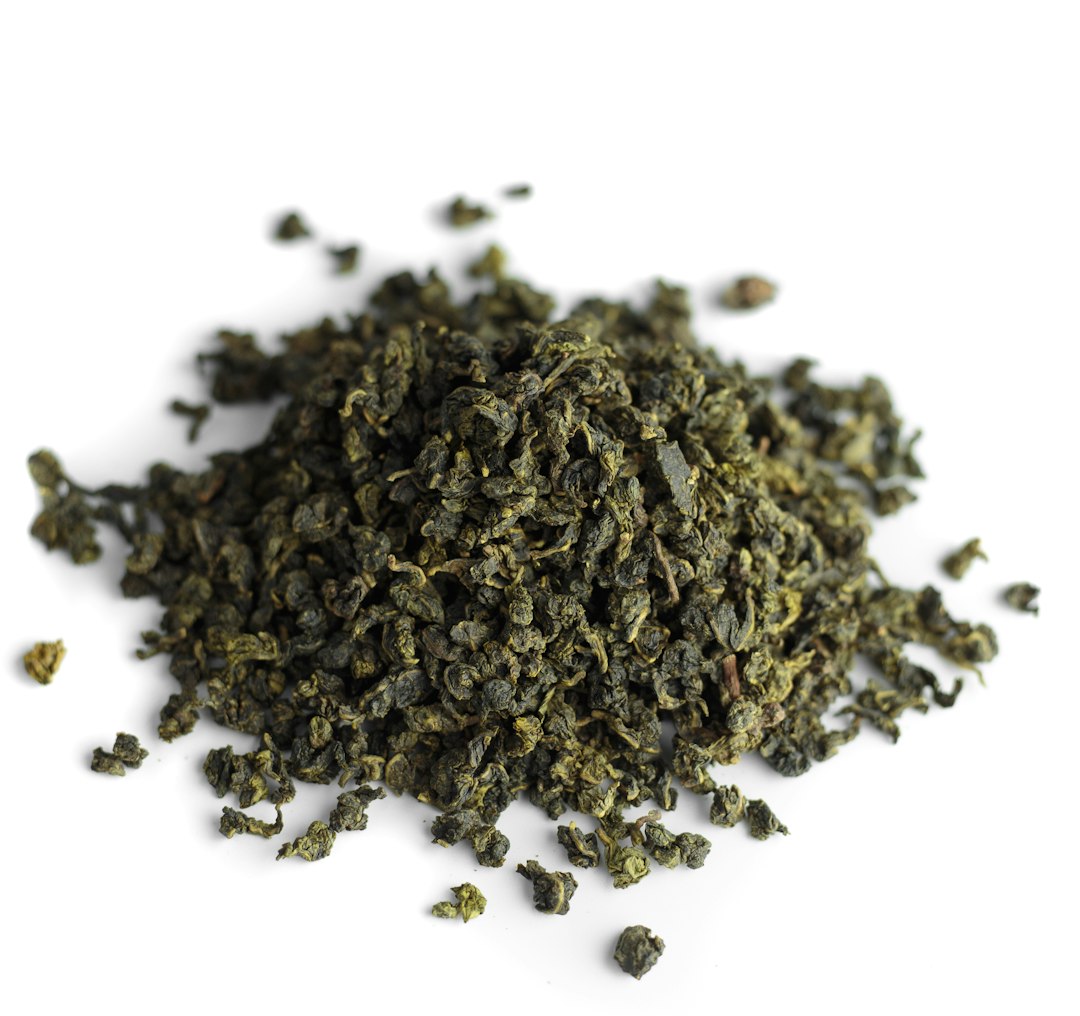
The basic steps are the same for most oolongs. For Tieguanyin from Anxi, China’s intangible cultural heritage list describes 16 steps after picking. In simplified form, it works like this:
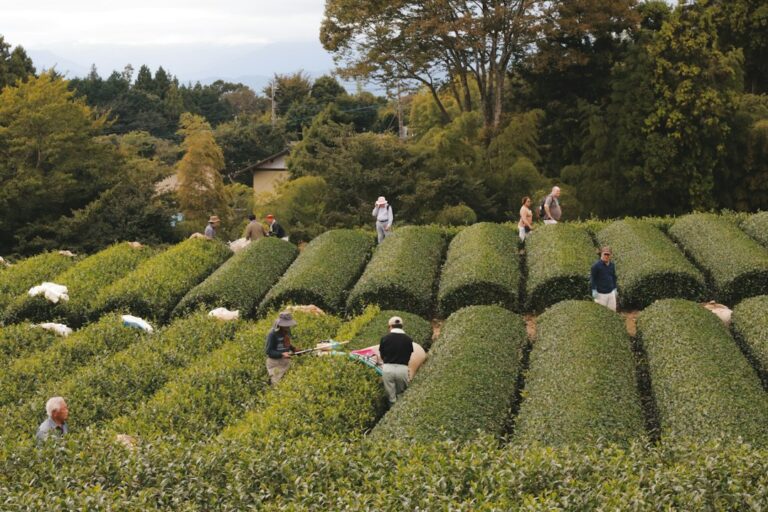
- Withering: The fresh leaves first lie in the sun and then cool down. They lose water and turn soft.
- Tossing: The leaves are moved in drums or sieves and rest in between. Their edges become bruised and oxidise first.
- Heating: Once the desired level is reached, brief, intense heat in a pan stops the enzymes.
- Rolling: The leaf is twisted into strands or kneaded into balls in cloths. With Tieguanyin, kneading and drying alternate several times.
- Drying and roasting: After drying, many producers roast the tea again with dry heat, sometimes over charcoal.
How hard the leaves are tossed shapes the aroma. Researchers from Fujian turned Tieguanyin leaves in a drum for up to nine rounds, with a 30-minute pause between each. As intensity rose, more fruity and green aroma compounds formed from fatty acids. They found the most pleasant aroma after five rounds, at medium intensity.
Oxidation and roasting are two separate steps. Oxidation happens in the fresh leaf before heating. Roasting comes at the end and shapes the finished tea a second time. A moderately oxidised oolong such as Dong Ding can therefore still be clearly roasted.
Fujian: Wuyi rock tea and Tieguanyin from Anxi
Fujian province in south-east China is regarded as the home of oolong. The province’s foreign affairs office calls the Wuyi Mountains in the north-west the birthplace of oolong and black tea. The teas from there are called rock teas and are known for their own rocky flavour. Farmers traditionally roast them over charcoal.
The best-known rock tea is Da Hong Pao, the Big Red Robe. Its six mother trees stand near Jiulongke by Tianxin Rock. They have not been harvested since 2006. Wuyi rock tea is a protected geographical indication, and the craft of making Da Hong Pao is on China’s national intangible heritage list.
In the south of Fujian lies Anxi County, the home of Tieguanyin. According to the heritage list, tea growing began there at the end of the Tang dynasty. The tea got its name, Iron Goddess of Mercy (Iron Guanyin), in the 18th century under the Qing emperors Yongzheng or Qianlong.
Taiwan: high mountain oolong, Dong Ding and Oriental Beauty
Oolong came to Taiwan from Fujian. In 1866 the British merchant John Dodd brought tea plants from Anxi to the island and lent farmers money to grow them. In 1869 he shipped crates labelled Formosa Oolong Tea from the port of Tamsui to New York.
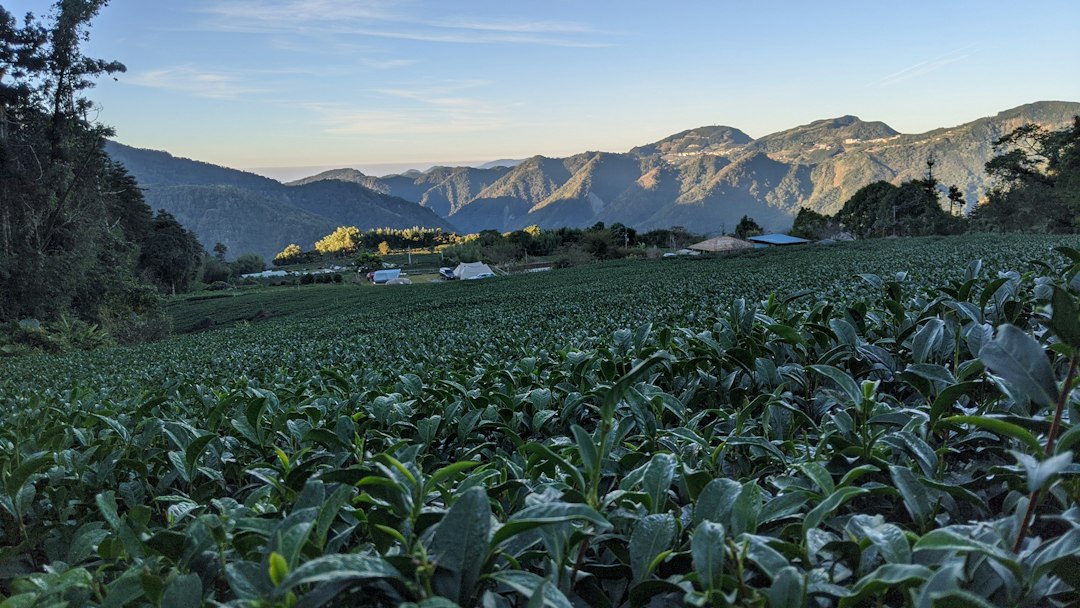
In Taiwan, tea gardens from about 1,000 metres upwards count as high mountain gardens, according to the state tea research station. The main cultivar there is Qingxin Wulong, and picking is done by hand. High mountain oolongs are rolled into semi-balls and only 20 to 30 per cent oxidised.
Dong Ding comes from Lugu township in Nantou County. Roasting is considered the decisive step, traditionally in a large wok over longan-wood charcoal. If the heat is too low, the tea turns bitter, according to Taiwan’s Ministry of Culture. Handmade Dong Ding turns amber, while machine-made tea tends to be pale gold.
Oriental Beauty, also called Baihao oolong, comes from Hsinchu County and from Shiding near Taipei. Buds and young leaves are picked in June and July. In summer the tea green leafhopper sucks on the shoots. A 2024 study shows that this infestation breaks down catechins and makes the tea less bitter and fruitier. New Taipei’s agriculture department describes an aroma of ripe fruit with hints of honey.
Flavour: floral and light or dark and toasty
How an oolong tastes depends mainly on oxidation and roasting. Lightly oxidised, barely roasted teas come across as floral and fresh. More oxidation brings fruity notes, and a strong roast brings toasty aromas. The table gives a rough overview of the best-known styles.
| Style | Examples | Typical impressions |
|---|---|---|
| light, lightly roasted | Wenshan Pouchong, high mountain oolong | floral, fresh, close to green tea |
| medium, roasted | Dong Ding from Lugu | toasty notes, infusion up to amber |
| dark, roasted over charcoal | Wuyi rock tea, Da Hong Pao | rocky flavour, fragrance of green tea, sweetness of black tea |
| heavily oxidised | Oriental Beauty, 60 to 70 % oxidised | ripe fruit, honey, hardly bitter |
A 2021 study on Tieguanyin measured what roasting changes in the leaf. The researchers roasted at 105°C and at 130°C. Roasting reduced bitterness and astringency and strengthened the sweet aftertaste. At high temperature, floral aroma compounds such as beta-ionone and nerolidol decreased, while roast compounds such as pyrazines increased.
Pyrazines also shape the aroma of roasted coffee. How light and dark roasts differ there is explained in light, medium and dark roasts. When buying oolong, it helps to read the details. Good retailers state the cultivar, origin and harvest year, and often how heavily the tea is oxidised and roasted.
Brewing: in a teapot or a gaiwan with many infusions
For a Western-style teapot, a German specialist tea retailer recommends 12 g of leaf per litre for Formosa oolong. That is 3 g for 250 ml. Pour on water at a rolling boil and let the tea steep for 3 minutes.
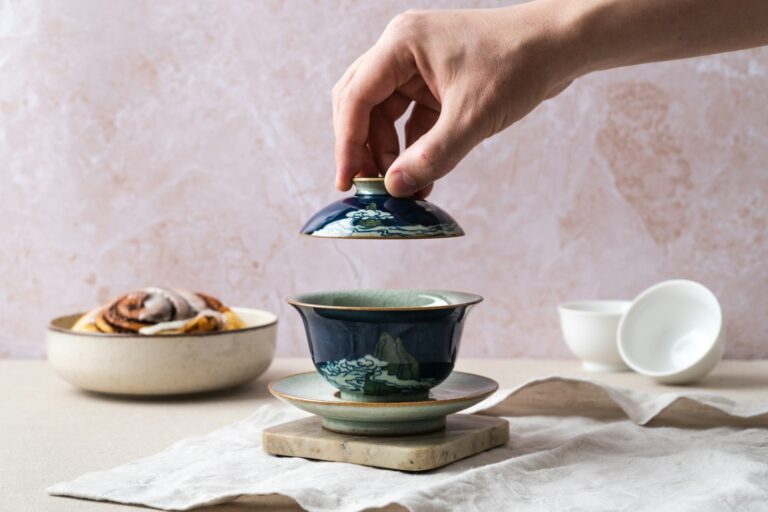
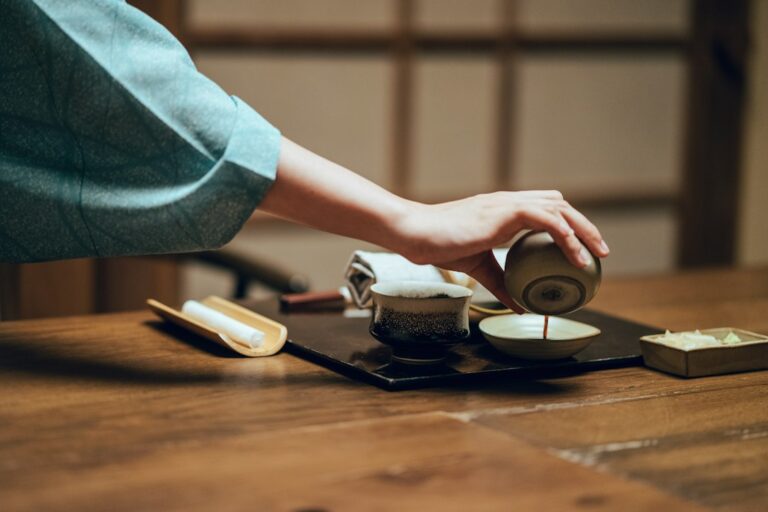
For gongfu style you use much more leaf and little water, and infuse the same leaves briefly several times. A gaiwan, a lidded bowl, or a small clay teapot works well for this. A London tea merchant recommends 4 to 6 g in a gaiwan. The first infusion steeps for 5 to 10 seconds, the following ones for 10 to 20 seconds. This way at least six infusions are possible.
A Swiss tea retailer distinguishes by leaf shape. Tightly rolled balls from Taiwan need longer in the first infusion, because the leaves have to open first. Loosely twisted teas from Wuyi or the Dancong oolongs from Guangdong should steep only briefly, as Dancong quickly turns bitter. Tieguanyin from Anxi sits in between, and for Oriental Beauty he uses slightly cooler water.
| Method | Leaf | Water | 1st infusion | After that |
|---|---|---|---|---|
| Teapot, Formosa oolong | 12 g per litre, 3 g per 250 ml | 100°C | 3 min | not specified |
| Gaiwan, general | 4 to 6 g | 100°C | 5 to 10 s | 10 to 20 s, at least 6 infusions |
| Gaiwan, tightly rolled (Taiwan) | 5 to 8 g / 110 ml | just under 100°C | 1.5 to 2 min | 30 s to 1 min, then longer |
| Gaiwan, twisted (Wuyi, Dancong) | 5 to 8 g / 110 ml | just under 100°C | 20 to 30 s | 10 to 20 s, then gradually longer |
| Gaiwan, Oriental Beauty | 5 to 8 g / 110 ml | 90 to 95°C | 20 to 30 s | 10 to 20 s, then longer |
So the retailers take different approaches to the first infusion of rolled oolongs. Following the London merchant, you briefly rinse tightly rolled oolongs with boiling water and pour it away after a few seconds. Open leaves such as Da Hong Pao do not need this. Basic rules for all types of tea are in how to brew tea properly.
How to get more out of your oolong:
- Weigh the tea, as large balls and twisted leaves are almost impossible to measure with a spoon.
- Pour off each infusion completely, otherwise the tea keeps steeping in the gaiwan.
- If an infusion turns bitter, shorten the next steeping time or use slightly cooler water.
- Extend the steeping time from infusion to infusion until the tea tastes thin.
- Use soft water, as hard water dulls delicate aromas. More on this in water for coffee.
To get started, pick a light oolong from Taiwan and a dark rock tea from Wuyi. Brew them one after the other in a gaiwan and compare the infusions. That way you can taste for yourself what oxidation and roasting do.
Last updated: 24 October 2026.
Sources
- Liou, B.-K.; Jaw, Y.-M.; Chuang, G. C.-C.; Yau, N. N. J.; Zhuang, Z.-Y.; Wang, L.-F., Foods 9(1):100: Important Sensory, Association, and Postprandial Perception Attributes Influencing Young Taiwanese Consumers’ Acceptance for Taiwanese Specialty Teas, 18 January 2020.
- China Intangible Cultural Heritage Network: 乌龙茶制作技艺(铁观音制作技艺), Tieguanyin production technique (in Chinese), listed 2008, accessed 24 October 2026.
- Ni et al., PeerJ 10:e13453: Effects of turning over intensity on fatty acid metabolites in postharvest leaves of Tieguanyin oolong tea (Camellia sinensis), 2022.
- Foreign Affairs Office of Fujian Province: Moments in Fujian: Wuyi Rock Tea, 27 July 2022.
- Taipei Travel, TAIPEI Quarterly Vol. 14: Dadaocheng and the history of Formosa Oolong Tea, 11 December 2018.
- Wang Wei-yi, Tea Research and Extension Station, Fengnian 58(24): 合理化施肥, 高海拔茶園合理化施肥 (fertilising high mountain tea gardens) (in Chinese), 16 December 2008.
- Ministry of Culture, Taiwan: Master of Handcrafted Tea: Su Wen-zhao, 19 July 2019.
- Agriculture Department, New Taipei City Government: Oriental Beauty Tea, undated, accessed 24 October 2026.
- Food Frontiers: Effect of tea green leafhopper (Empoasca onukii Matsuda) sucking on the quality of Oriental Beauty, July 2024.
- Food Chemistry: X: Sensory and chemical characteristics of Tieguanyin oolong tea after roasting, December 2021.
- TeeGschwendner, product page: Formosa Fancy Superior Oolong (in German), accessed 24 October 2026.
- Rare Tea Company (retailer information): How to Make Oolong with a Gaiwan, accessed 24 October 2026.
- Teamania, Benjamin Witt (retailer information): How to Brew Oolong Tea, 7 August 2020, updated 16 January 2024.