Germany is the second-largest buyer of rooibos after Japan: around 1,625 tonnes went there in 2024, 17 per cent of South African exports.The plants behind rooibos and honeybush, origin protection, red and green rooibos and how to brew them.
Rooibos and honeybush are often mentioned in the same breath, and for good reason. Both grow only in South Africa, both come from the fynbos vegetation, and neither is tea in the botanical sense. They do not come from the tea plant Camellia sinensis but from legumes. Rooibos infusion contains no caffeine.
Two shrubs from the fynbos: Aspalathus and Cyclopia
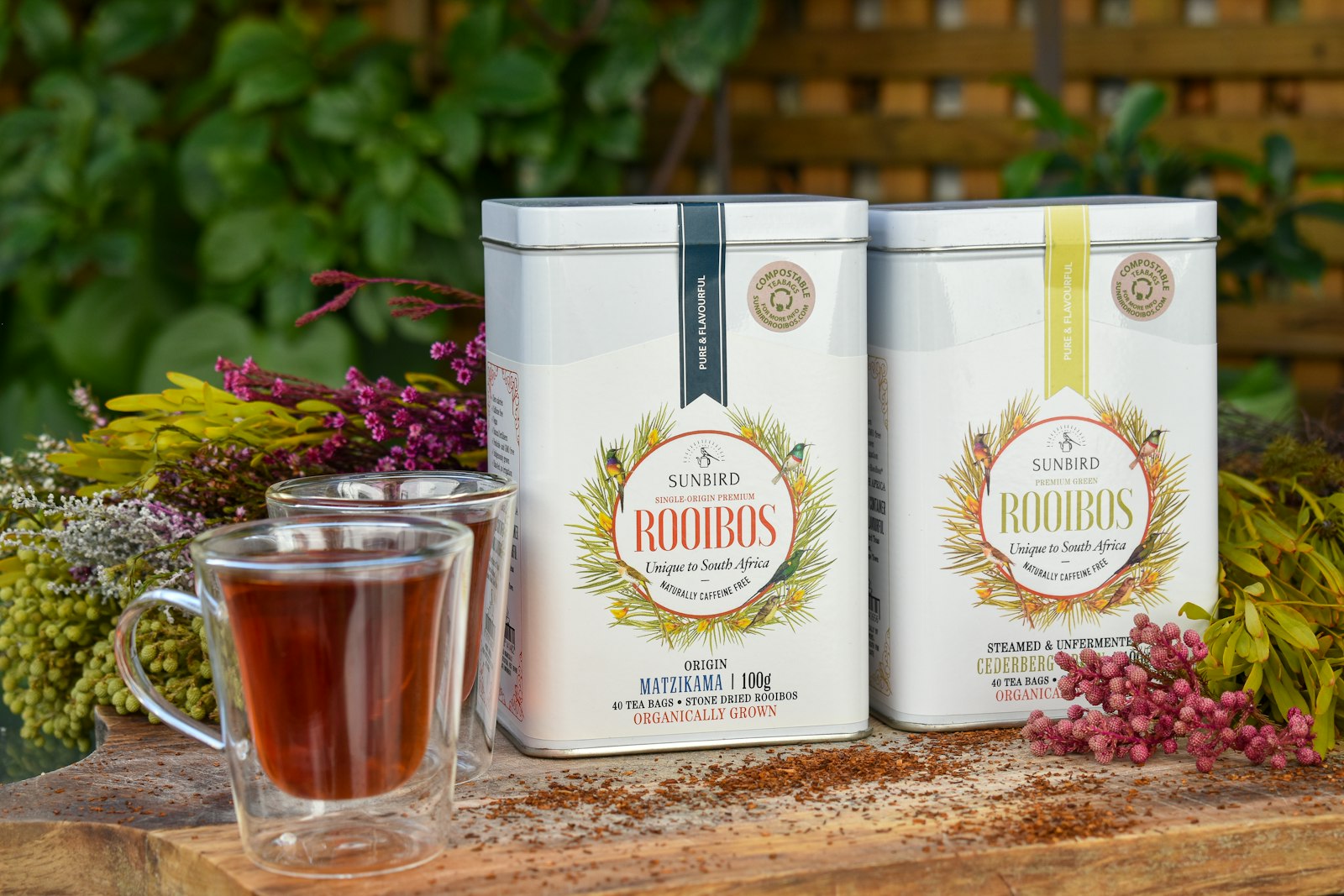
Botanically, rooibos is Aspalathus linearis and belongs to the legume family (Fabaceae). The broom-like shrub with needle-shaped leaves grows in the fynbos, the shrubland of the Cape. It is cultivated mainly in the Cederberg mountains in the Western Cape. The infusion contains no caffeine and relatively few tannins.
Honeybush is the collective name for species of the genus Cyclopia. According to South Africa’s Agricultural Research Council (ARC), 23 species are known. All of them grow only in the fynbos of the Western and Eastern Cape. The main commercially grown species are C. genistoides, C. longifolia and C. subternata.
Cederberg and EU origin protection: why only South Africa can supply ‘rooibos’
Since 2021, ‘Rooibos’ or ‘Red Bush’ has been registered in the EU as a protected designation of origin (PDO). Implementing Regulation (EU) 2021/865 dates from 28 May 2021. According to the EU Delegation to South Africa, it is the first African food with this status.
Since then, only products made from 100 per cent Aspalathus linearis may be sold as rooibos. They must be grown or wild-harvested in specified municipalities of the Western and Northern Cape. Blends with other teas or herbs are still allowed. According to the ARC, an application for EU geographical origin protection is also under way for honeybush. We have not been able to confirm its current status.
Red or green, wild or cultivated: how the infusions are made
Classic red rooibos is cut, bruised and oxidised, colloquially ‘fermented’. It then dries in the sun. Oxidation gives it its reddish-brown colour and its round, slightly malty flavour. For green rooibos, heating prevents oxidation, much as with green tea. It tastes fresher and grassier and usually costs more because the process takes more effort.
Much honeybush is still harvested from the wild. According to the ARC, more than 80 per cent of the annual harvest comes from the wild species Cyclopia intermedia. Research into deliberate cultivation only began in 1992. Traditionally, the shrubs were harvested in full bloom in spring.
| Rooibos | Honeybush | |
|---|---|---|
| Plant | Aspalathus linearis | Cyclopia, 23 species |
| Region | mainly Cederberg, Western and Northern Cape | fynbos in the Western and Eastern Cape |
| Source of the harvest | mostly cultivated, some wild-harvested | over 80 % wild-harvested (C. intermedia) |
| EU origin protection | PDO since 2021 | application in progress, according to the ARC |
Figures from South Africa: harvest, exports and Germany in second place
Sources disagree on production volumes. The South African Rooibos Council gives around 22,600 tonnes for 2023. The trade magazine Farmer’s Weekly reports 17,000 tonnes for 2023 and 14,000 tonnes for 2024, with around 13,000 tonnes expected for 2025. According to the magazine, harvests over ten years ranged between 10,000 and 18,000 tonnes.
According to Farmer’s Weekly, around 9,700 tonnes were exported in 2024, up from 5,900 tonnes in 2015. The industry employs around 8,000 people in farming and processing, according to the Rooibos Council.
| Rank | Country | Exports 2024 | Share |
|---|---|---|---|
| 1 | Japan | around 2,910 t | 30 % |
| 2 | Germany | around 1,625 t | 17 % |
| 3 | Netherlands | around 956 t | 10 % |
| 4 | United Kingdom | around 656 t | 7 % |
| 5 | France | around 568 t | 6 % |
We rounded the tonnes from the kilogram figures in Farmer’s Weekly.
Brewing it right: boiling hot and happily long
Rooibos is easy to brew. Use freshly boiled water at 100°C and about two teaspoons per cup. Steep it for at least three minutes; a German specialist retailer recommends five to eight minutes. The infusion does not turn bitter even after a long steep, so it is fine if you forget about it. You’ll find general rules on temperature and steeping time in our guide How to brew tea: temperature, steeping time and amount of leaf by type.
Red rooibos can take a splash of milk, while green rooibos is best drunk plain. For honeybush, follow the instructions on the pack. Rooibos contains no caffeine, so it is an alternative for the evening. Our overview of caffeine content in drinks shows how much caffeine coffee and tea contain.
How to get the best out of rooibos and honeybush:
- Brew with boiling water; rooibos does not need water that has cooled.
- Let it steep for at least 5 minutes; longer does not harm the flavour.
- When buying, look for ‘rooibos’ from South Africa, ideally with the PDO logo.
- Try green rooibos cold-brewed as iced tea in summer.
- Don’t drink rooibos as your only everyday drink; alternate it with other drinks.
San, Khoi and plant toxins: fairness and quality
In 2019, after negotiations that began in 2010, the rooibos industry reached a benefit-sharing agreement with representatives of the Khoikhoi and San. It recognises these communities as holders of traditional knowledge about rooibos. Since then, processors have paid a levy of 1.5 per cent of the price per kilogram they pay farmers. The money goes into two community trusts. It is considered the world’s first industry-wide agreement of its kind. You can read more about fair supply chains in coffee labels and direct trade.
Pyrrolizidine alkaloids (PA) are a quality issue. Plants produce these substances to deter predators, and they get into teas via plant parts that contain PA. In 2016, Germany’s Federal Institute for Risk Assessment (BfR) named contaminated teas as the main sources of intake. These included herbal teas such as rooibos, as well as black and green tea. The institute sees no acute health risk; the problem is long-term intake. EU maximum levels have applied since July 2022, now set out in Contaminants Regulation (EU) 2023/915.
| Product (dried) | Maximum PA level |
|---|---|
| Rooibos | 400 µg/kg |
| Herbal teas in general | 200 µg/kg |
| Black and green tea | 150 µg/kg |
| Teas and herbal teas for infants and young children | 75 µg/kg |
The BfR advises varying your drinks. Children should not drink herbal tea exclusively, and pregnant and breastfeeding women should combine herbal teas with other drinks.
Our recommendations
Rooibos · around €3.50 to €4
Lebensbaum Rooibos, organic, loose, 100 g
Pros: Lebensbaum specialises in organic tea and spices; this rooibos is pure and unflavoured, good for adding your own touches.
Cons: A more precise origin such as Cederberg is not given.
Teapot · around €33 to €37
Kinto Unitea One Touch Teapot 460 ml
Pros: Strainer and lid form one piece, and the leaves stay clearly visible during a long steep; pot and lid are dishwasher-safe.
Cons: At 460 millilitres it only holds 1 to 2 cups; made in China, and the lid must not go in the microwave.
Rooibos and honeybush are the easy-going relatives among infusions: no thermometer, no timer and, with rooibos, no caffeine. You’ll find more ideas for quiet afternoon tea breaks in Afternoon tea rituals: gongfu cha, East Frisian tea, hojicha.
All prices are guide prices and may change. We have not tested the products ourselves.
Last updated: 24 October 2026.
Sources
- Wikipedia: Rooibos, accessed 23 October 2026.
- Agricultural Research Council (ARC): The Honeybush Story, accessed 23 October 2026.
- Official Journal of the EU via lexaris: Durchführungsverordnung (EU) 2021/865 („Rooibos“/„Red Bush“ g.U.) (in German), 28 May 2021.
- SAnews: South African Rooibos makes list of EU’s protected designations, 10 June 2021.
- UK Tea & Infusions Association: European Commission approves the registration of Rooibos/Red Bush, 21 June 2021.
- South African Rooibos Council: GI and PDO, updated 16 September 2024.
- South African Rooibos Council: Industry Statistics, updated 1 October 2024.
- Farmer’s Weekly: Rooibos exports keeping the industry going, 25 February 2025.
- Whittard of Chelsea: A Guide to Rooibos, 20 August 2026.
- Teegalerie: Rooibos grün vom Zederberg Bio, accessed 23 October 2026.
- Natural Justice: The Rooibos Access and Benefit-sharing Agreement, 25 May 2020.
- University of Cape Town: San and Khoi claim benefits from rooibos, 20 November 2019.
- Bundesinstitut für Risikobewertung (BfR): Verunreinigungen in Tees und Honig sind die Hauptaufnahmequellen für Pyrrolizidinalkaloide (PA) (in German), 28 September 2016.
- legislation.gov.uk: Regulation (EU) 2020/2040, Annex, 11 December 2020.
- Eurofins: EU-Regularien: Anforderungen an die Gewürzbranche (in German), updated 30 June 2026.
- Violey: Lebensbaum organic rooibos tea, loose, price accessed 23 October 2026.
- KINTO Europe: UNITEA One Touch Teekanne 460 ml (in German), accessed 24 October 2026.
- Spürsinn24: Glaskanne mit Sieb UNITEA ONE TOUCH 460 ml (in German), accessed 24 October 2026.
- Barista und Espresso: Kinto UNITEA One Touch Teekanne (in German), accessed 24 October 2026.
Image credits
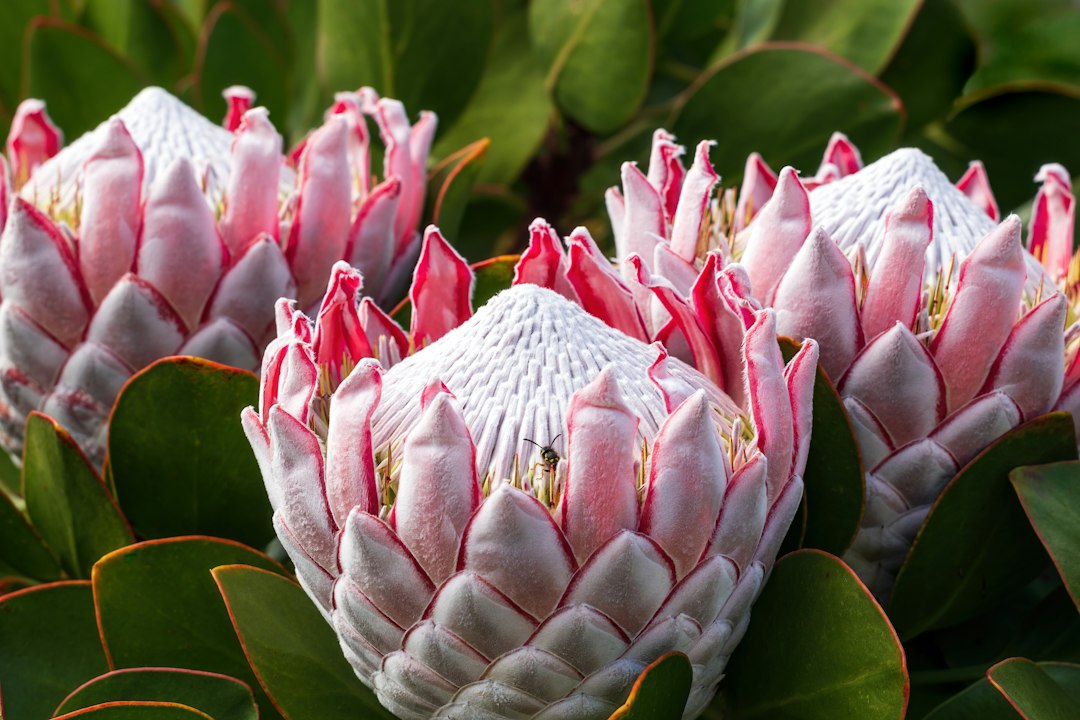
- Flower of a king protea, a typical fynbos plant – Photo: David Clode / Unsplash
Our selection is editorial, there are no paid placements. Links marked * are affiliate links to Amazon Germany (amazon.de): if you buy through them, we receive a small commission at no extra cost to you. We have not tested the products ourselves; pros and cons are based on manufacturer information and retailer descriptions. Prices are guide prices from German shops as of October 2026, and prices and availability on Amazon may differ.