For a matcha latte, sift 3 g of matcha, froth it with 100 ml of hot water, then add 100 ml of warm milk.Hot and iced recipes, tips against lumps, the right milk and caffeine per cup.
It usually starts in a café. The matcha latte there is pale green, smooth and creamy. At home you stir a spoonful of powder into hot milk. Green lumps float on top, a residue stays at the bottom, and the tea tastes flat.
Your ingredients are rarely to blame. Matcha is ground tea leaf and does not dissolve like instant coffee. With a sieve, a little water and the right order, you can make a latte as good as the café’s. It takes around five minutes.
Why matcha clumps: leaf powder, not a soluble extract
Matcha consists of very fine leaf particles. A Japanese study from 2003 measured particles of 1 to 100 micrometres in standard matcha. On average they were 11.5 micrometres, about a hundredth of a millimetre. Particles this fine stick together easily and form small lumps.
Static electricity adds to this. In a 2009 study, stone-milled matcha was electrostatically charged and flowed poorly. Powder from a ball mill flowed much better. How strong the charge was depended on the humidity.
When a lump like this lands in milk, only its outside gets wet. Inside it stays dry powder, which even long stirring hardly breaks up. Those were exactly the green specks in your first latte at home.
Moisture makes it worse. A tea retailer names a wet spoon, a poorly sealing tin and condensation as typical causes. If you keep matcha in the fridge, let the closed tin come to room temperature for 2 to 4 hours before opening it.
The basic recipe: 3 g matcha, 100 ml water, 100 ml milk
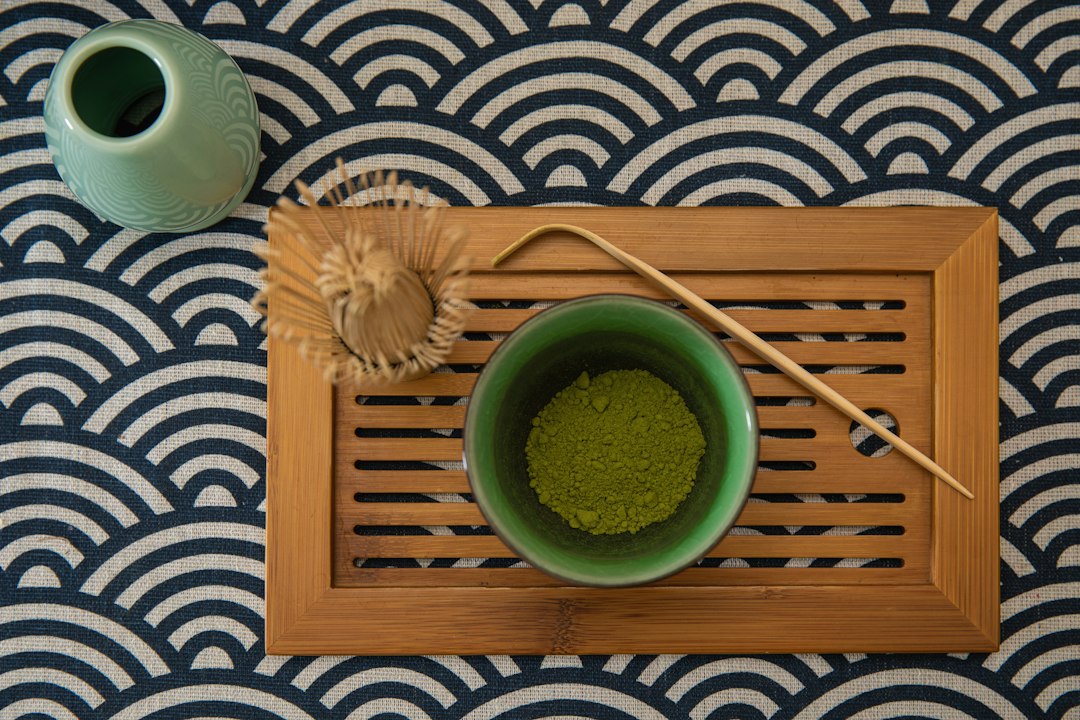
A tea house in Kyoto publishes a simple recipe for a hot matcha latte. You take 3 g of matcha, which is about 1.5 level teaspoons. Add 100 ml of water at 80°C and 100 ml of warm or frothed milk. In this ratio the tea is clearly in the foreground.
In 2017 the Japanese agriculture ministry printed a recipe with less water. It dissolves one teaspoon of matcha in around 20 ml of hot water. Then come 100 ml of milk, warmed and frothed with 3 g of sugar.
| Recipe | Matcha | Water | Milk | Other |
|---|---|---|---|---|
| hot (Kyoto tea house) | 3 g, 1.5 level tsp | 100 ml, 80°C | 100 ml, warm or frothed | whisk for 15 s |
| iced (Kyoto tea house) | 3 g | 100 ml, 80°C | 100 ml, cold | ice cubes |
| Japanese agriculture ministry (2017) | 1 tsp, around 2 g | around 20 ml, hot | 100 ml, warmed and frothed | 3 g sugar to taste |
We derived the weight of one teaspoon from the Kyoto recipe. Making it takes four steps:
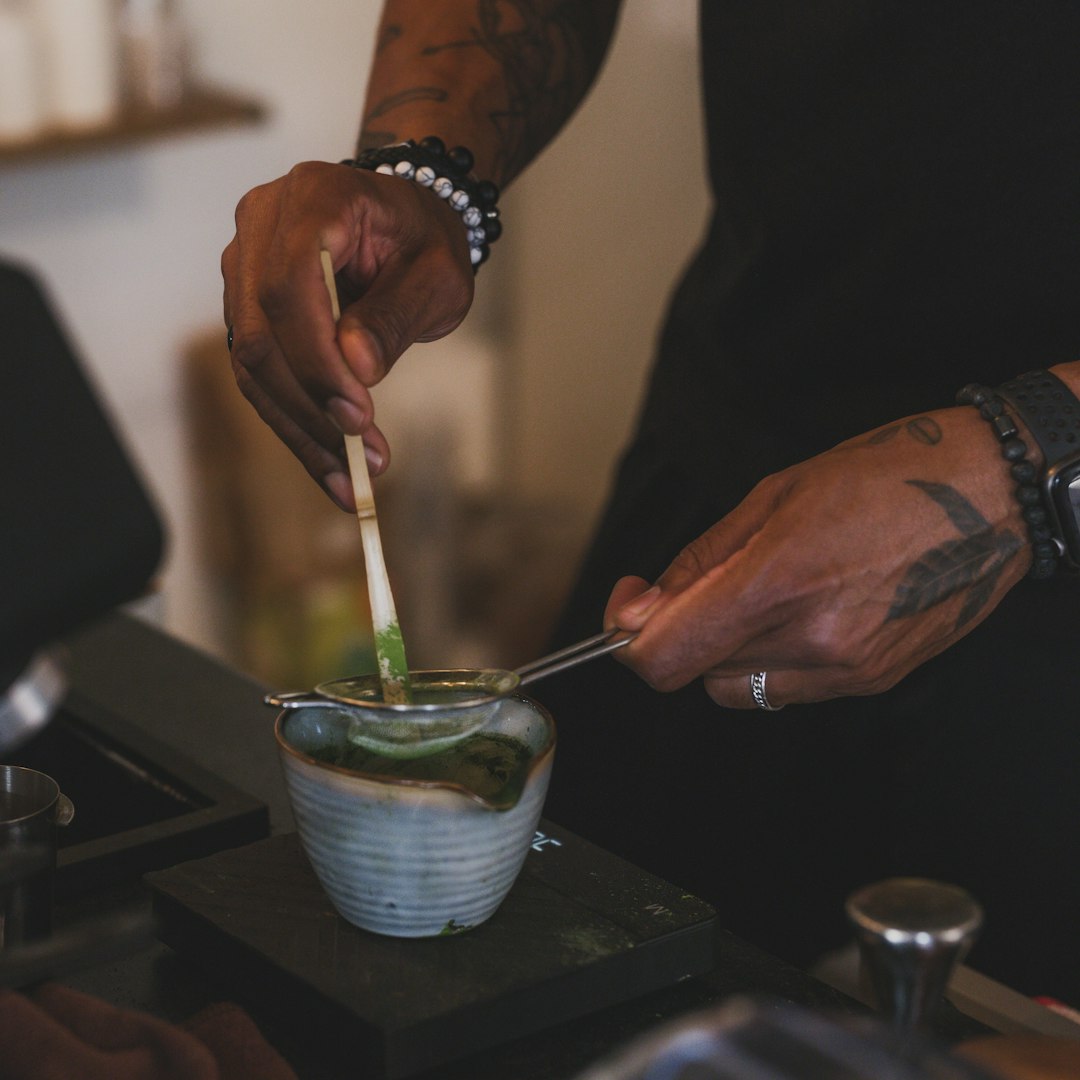
- Sift: Push the matcha through a fine tea sieve into a bowl or wide cup.
- Cool the water: Pour boiling water into a cup first and then into the bowl. Pouring it over cools it to about 80°C, as the tea house describes.
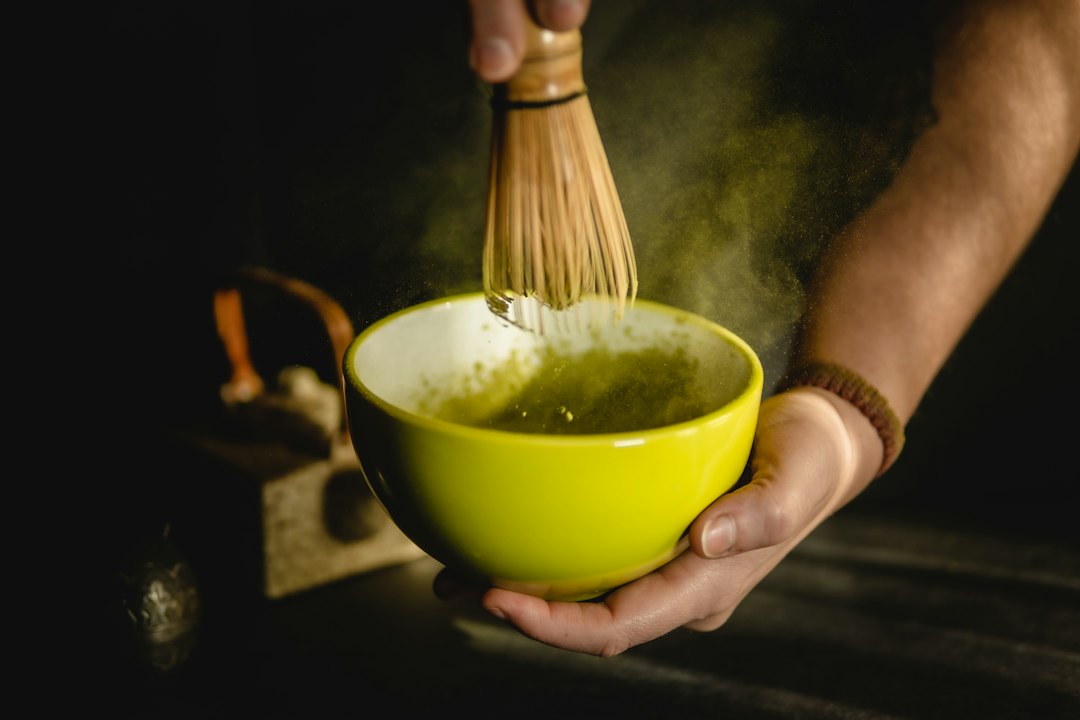
- Whisk: Whisk the powder and water vigorously in an M-shaped motion for 15 seconds until a fine froth forms.
- Add the milk: Pour the warm or frothed milk onto the concentrate and give it a quick swirl.
Sift and whisk: how to get rid of the lumps
The sieve comes first in both of the Kyoto tea house’s recipes. It breaks up the lumps before the powder gets wet. The easiest way is to push the powder through the mesh with a teaspoon.
The second point is the order. In a little water, the bamboo whisk (chasen) disperses the particles well. In a full cup of milk that hardly works. That is why the milk always goes in last.
The particles never disappear completely, because they do not dissolve. They only float in the drink, and larger ones sink over time. A little green sediment at the bottom of the cup is therefore normal. The table helps with the most common problems.
| What you see | Likely cause | What helps |
|---|---|---|
| green specks in the foam | powder not sifted, dry lumps | sift and whisk in a little water first |
| powder cakes in the tin | moisture, wet spoon, condensation | dry spoon, let a cold tin warm up first |
| green sediment at the bottom | larger particles sink | swirl before drinking |
| milk tastes flat or cooked | milk frothed too hot | stop cow’s milk at 65°C at most |
How to make your matcha latte smooth:
- Weigh the matcha once so you know how much fits on your spoon.
- Sift the powder straight into the bowl and push it through with the spoon.
- Whisk the concentrate in a little water, never directly in the milk.
- Always use a dry spoon and bowl, as water makes the powder clump.
- Close the tin again straight away: light, air and moisture harm the powder.
Milk and plant-based drinks: temperature and foam
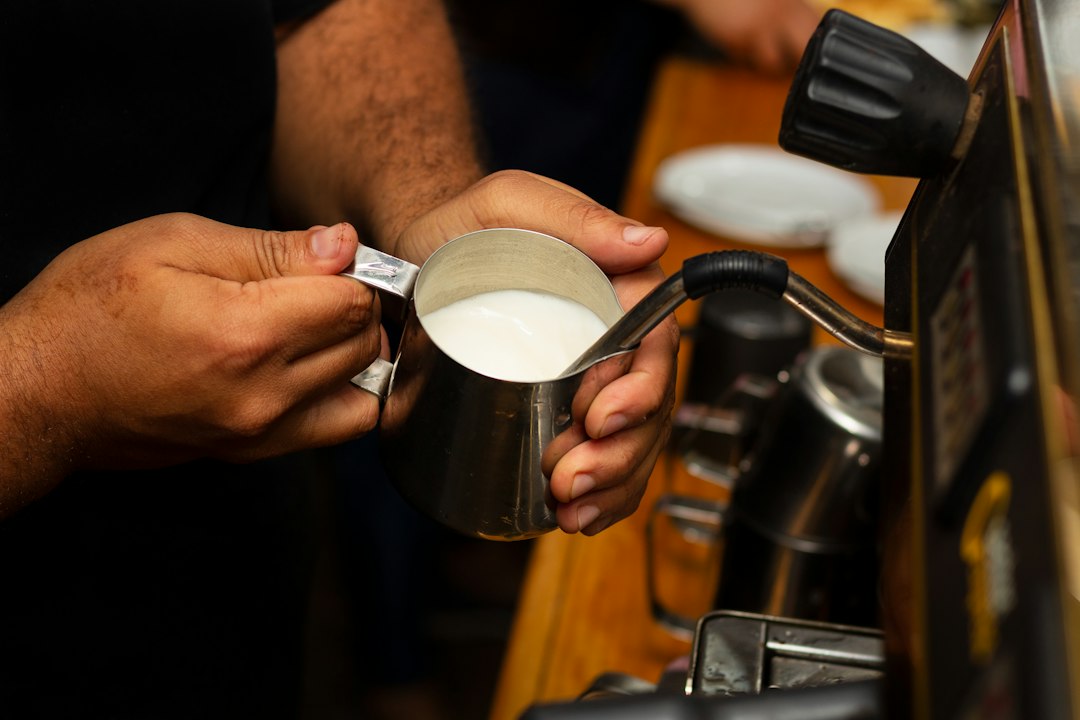
Warm and froth the milk as you would for a cappuccino. A roastery in Heidelberg gives 55 to 65°C for cow’s milk, and 55 to 60°C for maximum sweetness. Above that, sweetness is lost. Froth plant-based drinks a little cooler.
| Milk | Guide value | Source |
|---|---|---|
| cow’s milk | 55 to 65°C | Heidelberg roastery |
| cow’s milk, as sweet as possible | 55 to 60°C | Heidelberg roastery |
| barista oat drink | around 55 to 60°C | Swiss roastery |
| upper limit | above 70°C sweetness is lost | Swiss roastery |
There are measurable differences in the foam. A 2024 study compared cow’s and goat’s milk with six plant-based drinks. At 65°C the animal milks produced more foam. At 10°C, oat, soya and almond drinks foamed more and for longer, and across all tests oat foam lasted longest.
For a hot latte, cow’s milk or a barista oat drink works well. How to go about it with a steam wand or a frother is explained in milk foam for cappuccino and oat drink.
Iced matcha latte: concentrate over milk and ice
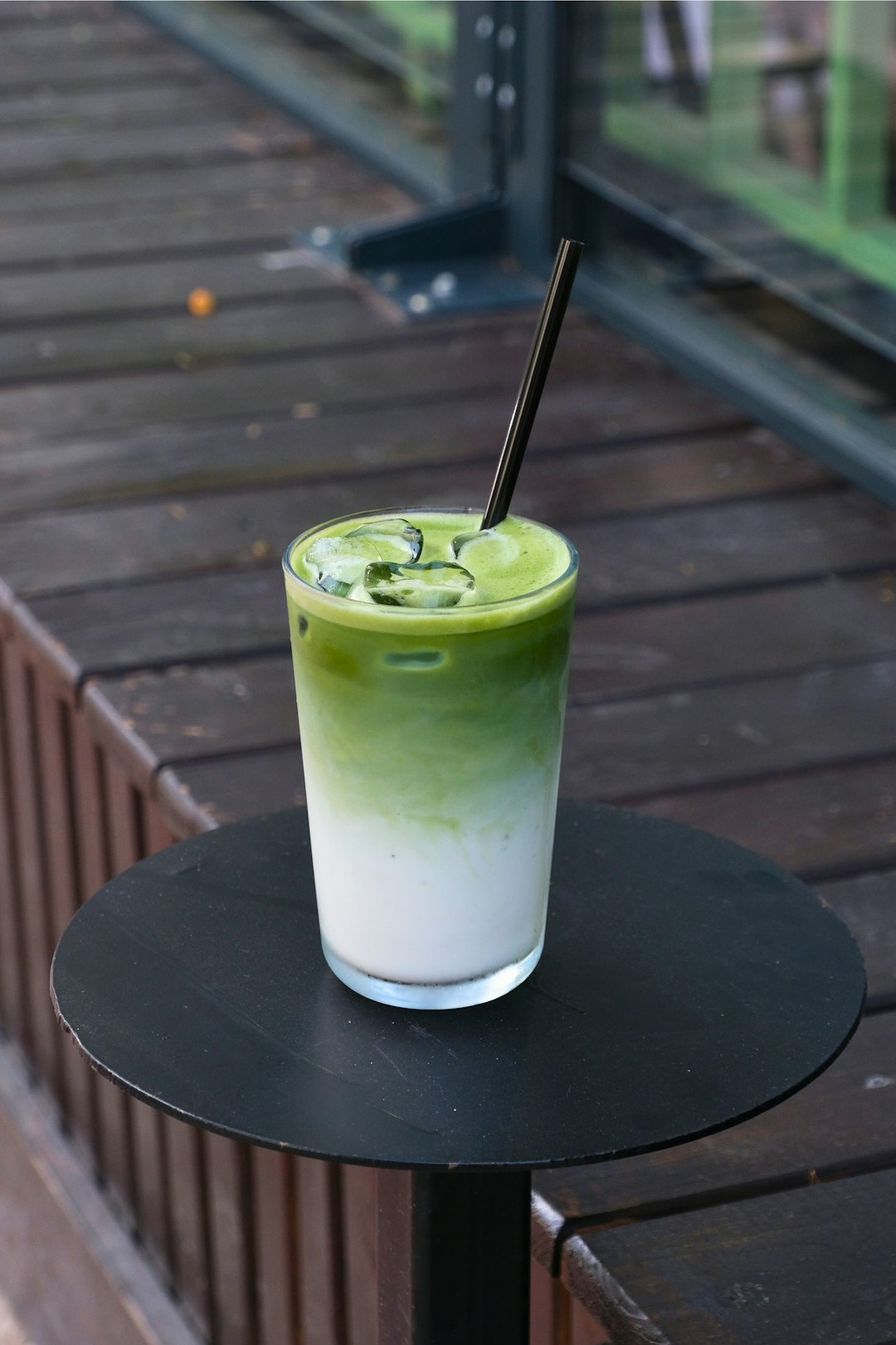
For the cold version too, the Kyoto tea house whisks the matcha with water at 80°C. First 100 ml of cold milk and ice go into the glass. You pour the concentrate over the top last. This creates the two colour layers you know from the café.
The warm concentrate melts some of the ice, which thins the drink. With more ice or a briefly cooled concentrate it stays stronger. That is our assessment, the recipe says nothing about it.
For cold milk foam on top, a plant-based drink works better. In the 2024 study, oat, soya and almond foamed more than cow’s milk at 10°C.
Powder, sweetness and caffeine: what ends up in your cup
In shops, matcha is often labelled ceremonial or culinary grade. A Japanese tea retailer writes that Japan has no official grading system for this. According to the retailer, culinary grade is more astringent and intended for lattes and baking. Astringency is less noticeable in milk, so the powder does not have to be the most expensive.
Sweetening is a matter of taste. The agriculture ministry uses 3 g of sugar per 100 ml of milk. Honey or syrup is best stirred into the warm concentrate before the milk goes in.
For caffeine only the powder counts, and milk does not change it. The Japanese food composition table gives an average of 32 mg of caffeine per gram of matcha. Measurements of shop-bought powders were mostly between about 15 and 35 mg per gram.
| Cup | Powder | Caffeine at average value | Range (our conversion) |
|---|---|---|---|
| latte, agriculture ministry recipe | 1 tsp, around 2 g | around 64 mg | around 30 to 70 mg |
| latte, tea house recipe | 3 g | around 96 mg | around 43 to 105 mg |
| for comparison: espresso (BfR) | around 80 mg |
A latte with 3 g of powder is therefore roughly on a par with an espresso, and slightly above it at the average value. EFSA, the European Food Safety Authority, considers up to 200 mg at once and up to 400 mg a day safe for healthy adults. You can read more about caffeine values and L-theanine in how much caffeine does matcha have?.
So you don’t need a café machine for a smooth matcha latte. Sift the powder, whisk it in a little water and pour in the milk last. The lumps from your first attempt will then stay in the sieve. Why water temperature matters so much for tea is explained in how to brew tea properly.
Last updated: 24 October 2026.
Sources
- Ippodo Tea (retailer information): Matcha Latte Recipe, undated, accessed 24 October 2026.
- Ippodo Tea (retailer information): Iced Matcha Latte, undated, accessed 24 October 2026.
- Japanese Ministry of Agriculture, Forestry and Fisheries (MAFF), aff April 2017: 特集2 抹茶(2), matcha latte recipe (in Japanese), April 2017.
- Haraguchi, Y.; Imada, Y.; Sawamura, S., Nippon Shokuhin Kagaku Kogaku Kaishi 50(10), 468 to 473: Production and characterization of fine matcha for processed food, 2003.
- Sawamura, S.; Haraguchi, Y.; Yasuda, M.; Matsusaka, S., Nippon Shokuhin Kagaku Kogaku Kaishi 56(2), 103 to 107: Flowability Properties of Matcha Varying with Particle Size and Milling Method, 15 February 2009.
- Yunomi (retailer information): How Matcha Storage Temperature Affects Quality, 30 July 2025.
- Simon Kuch, Simon & Bearns: Flat White vs. Cappuccino: Differences and Preparation, 22 October 2025.
- Benjamin Hohlmann, Kaffeemacher: Flat White, 5 July 2026.
- Hassan, L. et al., Soft Matter 20, 8215 to 8229: The bubbly life and death of animal and plant milk foams, 18 September 2024.
- Ikkyu Tea, Bloise Aldo (retailer information): Ceremonial vs. Culinary Matcha: Why ‘Ceremonial Grade’ Isn’t a Japanese Classification, 5 November 2025.
- MEXT, Standard Tables of Food Composition in Japan (8th edition, 2023 supplement), via calorie.slism.jp: 抹茶 (matcha, powder) (in Japanese), accessed 24 October 2026.
- Meyer, B. R.; White, H. M.; McCormack, J. D.; Niemeyer, E. D., Plant Foods for Human Nutrition 78(4): Catechin Composition, Phenolic Content, and Antioxidant Properties of Commercially-Available Bagged, Gunpowder, and Matcha Green Teas, 3 November 2023.
- Kika, J. et al., Foods 13(8):1167, with values from Koláčková et al. 2020: Matcha Green Tea: Chemical Composition, Phenolic Acids, Caffeine and Fatty Acid Profile, 11 April 2024.
- Bundesinstitut für Risikobewertung (BfR, Germany’s Federal Institute for Risk Assessment): Fragen und Antworten zu Koffein und koffeinhaltigen Lebensmitteln, einschließlich Energy Drinks (in German), as of 5 January 2026.
- European Food Safety Authority (EFSA): Caffeine (topic page on the opinion of 27 May 2015), accessed 24 October 2026.