Fill the base with hot water, add medium-fine coffee loosely to the basket and take the pot off the heat as soon as it hisses.How it works and the pressure, step-by-step instructions, common mistakes, cleaning, and aluminium, stainless steel and induction.
For many people, it already stood in their grandparents’ kitchen. The octagonal pot went on the hob with cold water, at some point it bubbled, and the coffee smelled strong. Sometimes it also tasted bitter, because the pot stayed on the heat for a while longer.
The design dates from 1933, and today the Museum of Modern Art in New York holds it in its collection. Good results depend on a few simple steps. Almost all of them concern water, grind size and the moment you take the pot off the heat.
How the pot works: steam pressure instead of a pump
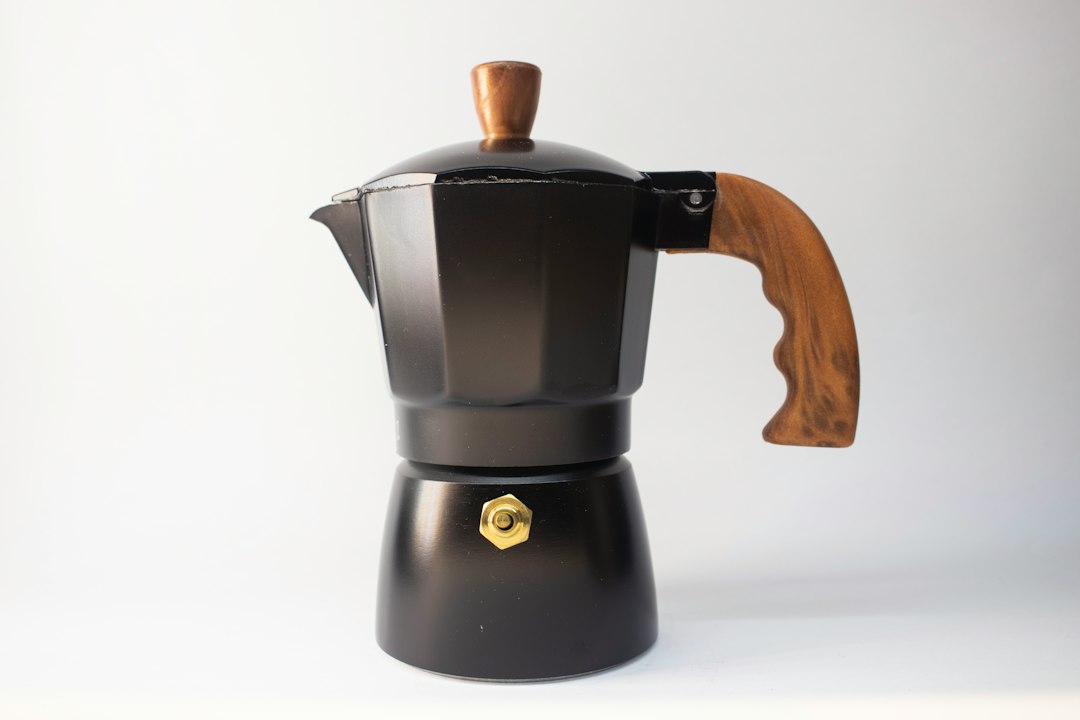
A moka pot (stovetop espresso maker) has three parts. At the bottom is the base with the water, and above it the funnel with the ground coffee. At the top sits the upper chamber for the finished coffee. As it heats up, air and steam in the base expand. The pressure pushes the water up through a riser tube, through the coffee and into the upper chamber.
For a long time it was said that the water first had to boil. Measurements by a team at the University of Trieste from 2009 show something different. Extraction already starts at fairly low water temperatures. Exactly when also depends on how much air is in the base at the start.
It does not produce espresso, even though the device is often named after it. According to the roastery Kaffeemacher, the pressure in the main phase is around 1 to 1.5 bar. According to the roastery, one manufacturer gives an operating pressure of 1.5 bar for its classic pot. An espresso machine works at around 9 bar.
| Moka pot | Espresso from an espresso machine | |
|---|---|---|
| Pressure | around 1 to 1.5 bar | around 9 bar |
| Starting recipe | 12 g of coffee to 120 ml of water (1:10) | 18 g of coffee to 36 to 45 g of espresso (1:2 to 1:2.5) |
| Brew time | 2:30 to 4:00 minutes | 25 to 30 seconds |
| Grind size | between sand and fine sugar | fine, first small clumps |
| Dissolved solids (TDS) | 3 to 4 % | 6 to 10 % |
The espresso machine values are explained in our guide to dialling in espresso. This makes moka coffee about half as concentrated as espresso. With hot milk it becomes a simple milky coffee.
Step by step: from hot water to the hiss
For the small pot, Kaffeemacher gives 12 g of coffee to around 120 ml of water. For larger pots, the basket determines the amount.
- Preheat the water: Heat the water in the kettle and pour it hot into the base, up to just below the safety valve.
- Grind: Grind the coffee finer than for filter coffee and a little coarser than for espresso. The texture is between sand and fine sugar.
- Fill loosely: Fill the basket to the rim without a heap and level it off. Do not press the coffee down.
- Clean the rim: Wipe crumbs off the rim of the base. Hold the hot base with a cloth and screw the pot tightly together.
- On the heat: Put the pot on the hob. On gas, the flame should not reach out beyond the sides of the base, otherwise the handle gets hot.
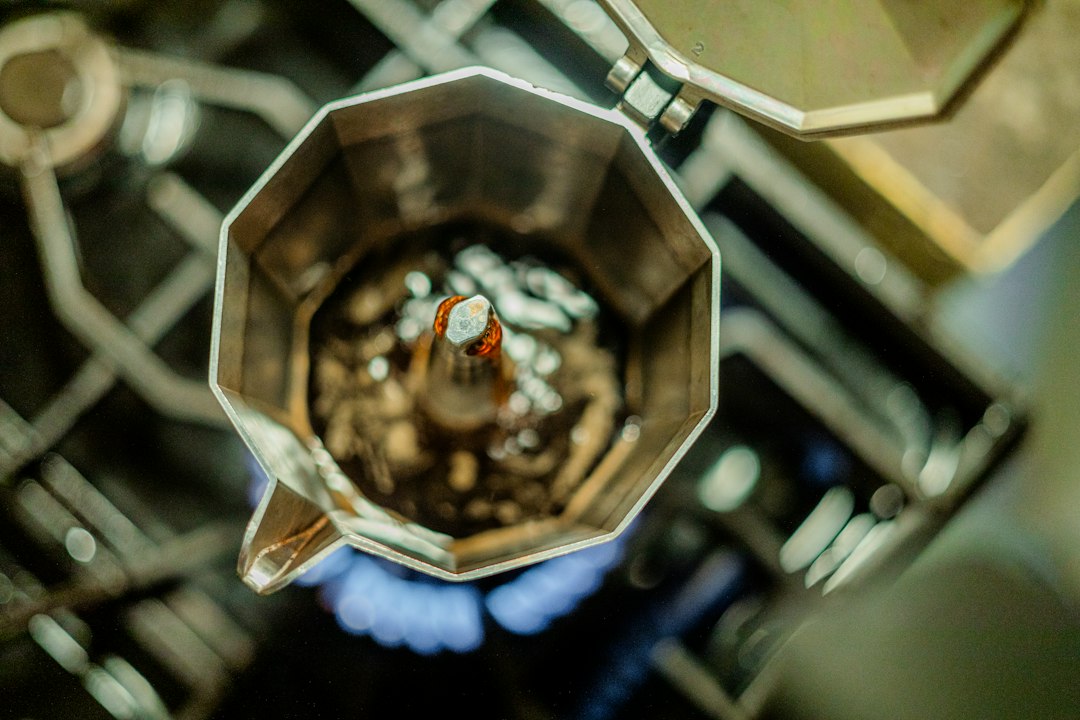
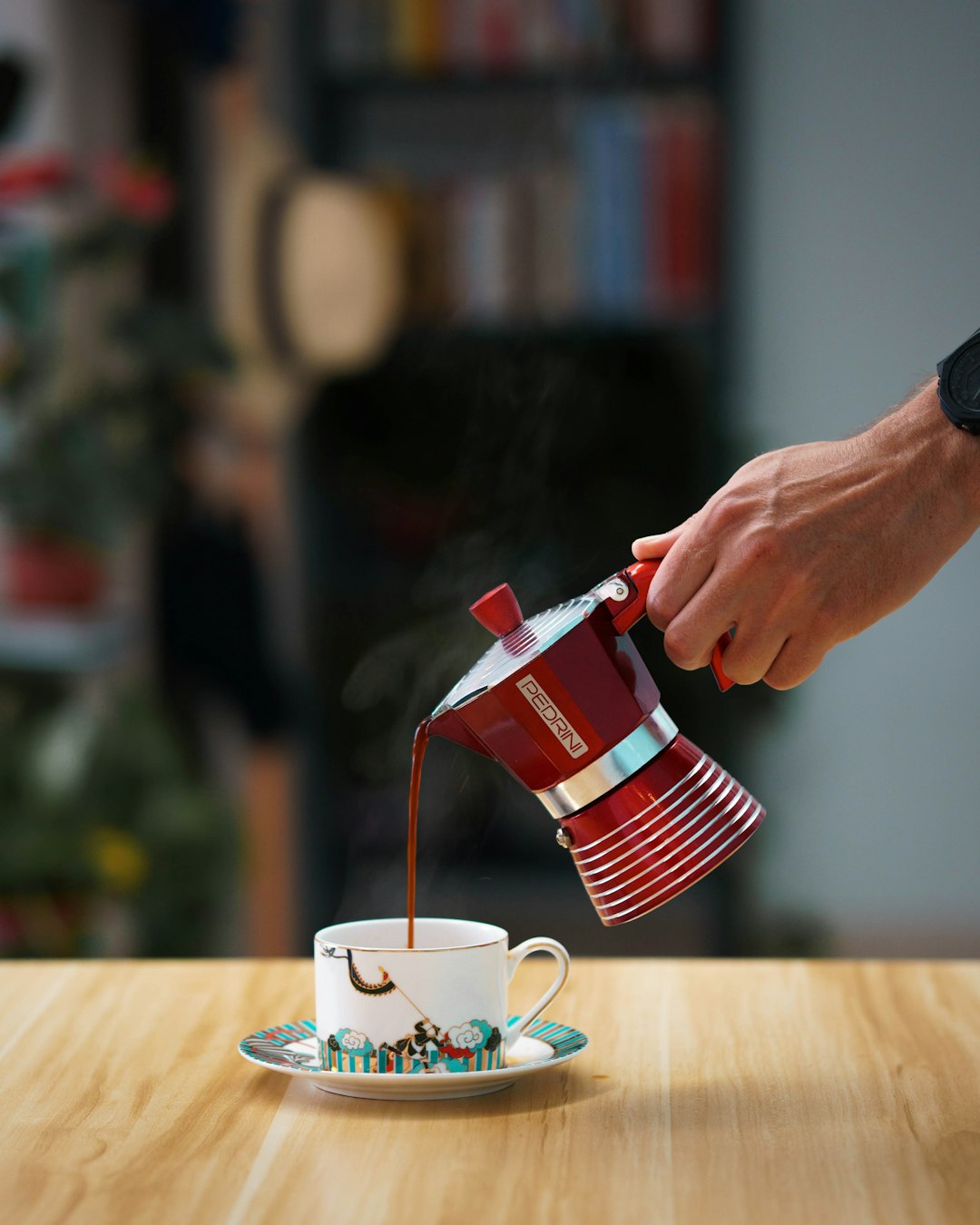
- Stop: As soon as it bubbles and hisses at the top, take the pot off the heat. Stir the coffee briefly and pour it straight away.
There is a simple reason for the hot water. With cold water, the coffee sits on the hot pot for a long time before anything rises, and it heats up through the metal. According to Kaffeemacher, preheated water noticeably improves the coffee because the grounds spend less time in the steam.
Pressing the coffee down lengthens the brew time, and the coffee turns bitter. Coffeeness also warns against too much pressure in the base. Very finely ground, compacted coffee can make the basket so dense that steam escapes from the safety valve. Then the pot must come off the heat immediately. Many hand grinders can manage a suitable grind size, and what matters is explained in hand grinders for espresso and filter.
How to find your setting:
- The first time, weigh coffee and water and time it from putting the pot on to the hiss.
- If the coffee takes longer than 4 minutes and tastes bitter, grind a little coarser next time.
- For light roasts, place a round paper filter from the AeroPress on the coffee. It catches fine particles.
- Keep the lid closed while brewing until you know your pot. With high heat, coffee can otherwise spurt out.
- Note the grind setting and time, then you only need to fine-tune slightly with the next bag.
Heat and timing: listen for the hiss
Kaffeemacher works with full heat and pays attention above all to the brew time. For the 120 ml pot, the roastery gives 2:30 to 3:30 minutes, for the 300 ml pot 3:00 to 4:00 minutes.
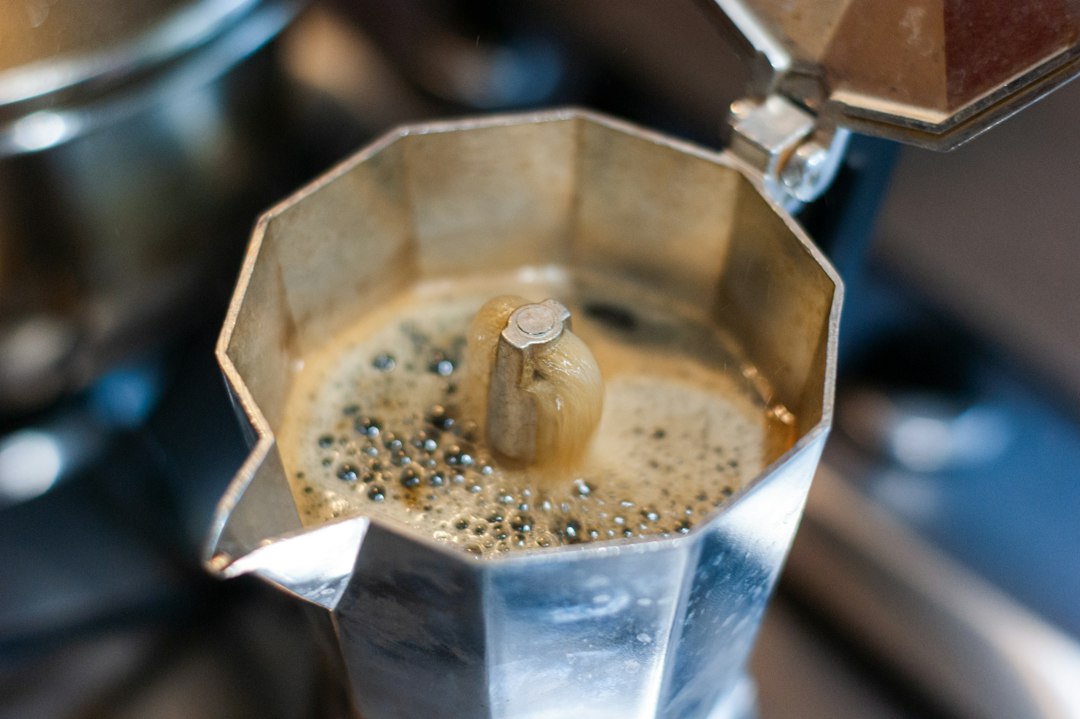
The end is what counts. As long as the riser tube is in the water, water flows through the coffee. When the water level drops below it, a mixture of water and steam comes up, and it bubbles and hisses. According to Kaffeemacher, mainly bitter compounds dissolve in this last phase.
Many people know exactly this bubbling from their grandparents’ kitchen, often as a sign that the coffee is ready. If the pot then stays on the hob, the coffee keeps boiling at the top. Coffeeness calls this double brewing, and the coffee tastes burnt. So take the pot off at the first hiss and pour the coffee straight away.
Bitter, thin, metallic: mistakes and their causes
The overview sums up the advice from Kaffeemacher and Coffeeness. Only ever change one thing at a time.
| Fault | Common cause | What to change |
|---|---|---|
| bitter, burnt | pot left on the hob after the hiss | take off at the first hiss, pour immediately |
| bitter, brew time over 4 minutes | ground too fine or pressed down | grind coarser, fill loosely |
| thin, runs very fast | ground too coarse or basket not full | grind a little finer, fill the basket to the rim |
| metallic with a new pot | surface not yet seasoned | pour away the first two to three pots |
| musty off-taste | coffee residue on basket and gasket | check and clean the basket and gasket |
| steam from the valve | basket clogged by very fine grounds | off the heat immediately, grind coarser |
According to Kaffeemacher, the metallic taste disappears after two to three brews. With stainless steel pots, the roastery says this seasoning is not necessary.
Cleaning and care: water instead of the dishwasher
An aluminium pot does not belong in the dishwasher. Kaffeemacher advises rinsing it with water only and avoiding washing-up liquid, unless the manufacturer expressly allows it. Once it has cooled, unscrew it, knock out the grounds and let all the parts dry well.
The matt grey inside of an older aluminium pot is not dirt. It is an oxide layer that, according to Coffeeness, limits the transfer of particles into the coffee. So only wipe it out gently and do not scour it shiny.
- Gasket: Check the rubber ring before brewing. If it is hard, cracked or full of residue, replace it. It does not belong in the dishwasher.
- Safety valve: The valve on the base must be clear and free of limescale.
Aluminium or stainless steel: what the measurements show
Aluminium conducts heat well and is light and cheap, so the pot heats up quickly. Stainless steel heats more slowly, is heavier and, according to Coffeeness, is dishwasher-safe. A German research team measured in 2017 how much aluminium passes into the coffee.
It tested three aluminium pots and, for comparison, one made of stainless steel, each with 12 g of coffee to 150 ml of water. It then converted the values for a 70 kg adult who drinks 3.17 litres of coffee a week.
| Situation | Result of the study |
|---|---|
| new aluminium pot, first brew | highest value in the series |
| after one to two brews | much lower, surface passivated |
| after one dishwasher cycle | much higher again, up to 0.795 mg of aluminium per litre |
| this maximum, extrapolated | up to about 4 % of the tolerable weekly intake |
| stainless steel pot | lower than aluminium in all 18 comparisons, 13 of them statistically significant |
The authors consider the contribution of a correctly used pot negligible, even in the worst case. The study has its limits. Only four pots, one coffee and one brewing method were tested, and children were not considered.
The Bundesinstitut für Risikobewertung (Germany’s Federal Institute for Risk Assessment, BfR) puts this in a wider context. Food alone gives the average person about half the tolerable weekly intake, and parts of the population clearly exceed it. The BfR therefore advises reducing avoidable sources. Acidic or salty foods should not be prepared or stored in uncoated aluminium.
So season a new aluminium pot a few times and never put it in the dishwasher. If you want to avoid every additional source, choose stainless steel.
A pure aluminium pot does not work on induction. The hob needs a ferromagnetic base, and even stainless steel is only magnetic in certain alloys. One hob manufacturer recommends the magnet test. If a magnet sticks to the base, the pot will work. There are adapter plates for aluminium pots, and at the end of 2024 Coffeeness gave around €23 for one of them.
One question applies to all materials. Because the coffee runs through a metal basket, it contains cafestol, a fatty substance from the bean that can raise cholesterol. In laboratory measurements from Nottingham in 2012, a 60 ml cup contained 1.1 to 2.4 mg. French press came to 4.1 to 11.9 mg per 160 ml there. How to interpret these values is explained in unfiltered coffee and cholesterol.
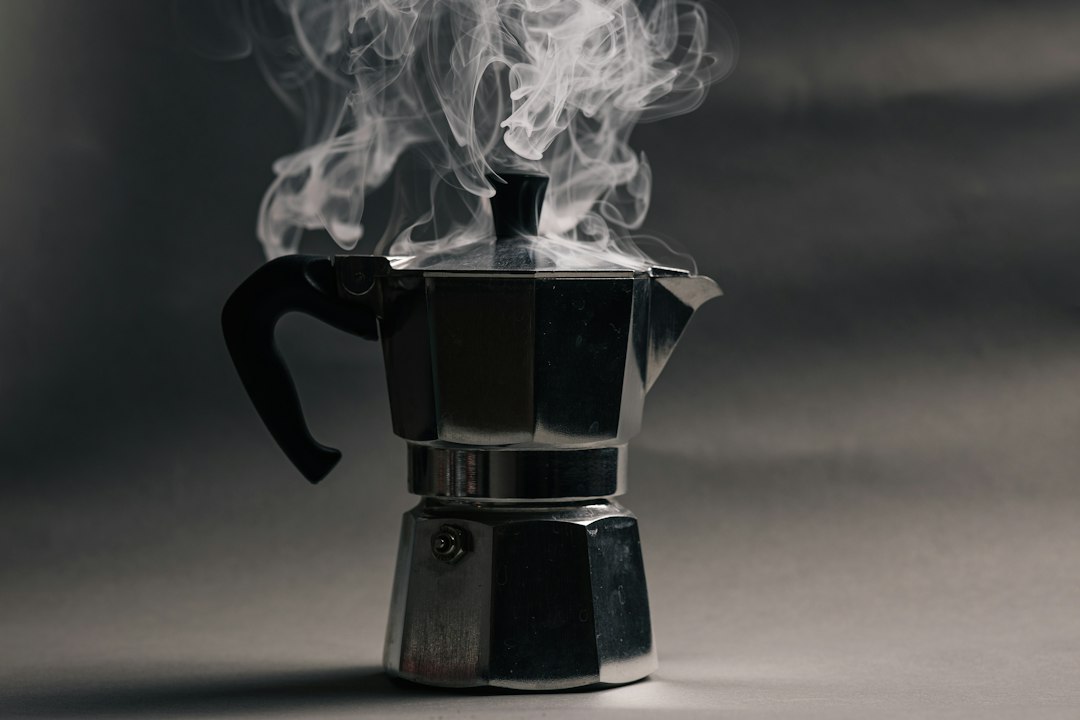
The difference from your grandparents’ pot comes down to three simple steps. Hot water in the base, coffee loosely in the basket, and off the heat at the first hiss. You control the rest with the grind size.
Last updated: 24 October 2026.
Sources
- Benjamin Hohlmann, Kaffeemacher: Espressokocher (Mokka-Kanne): Anleitung, Rezepte und Tipps vom Barista (in German), 13 April 2026.
- Navarini, L.; Nobile, E.; Pinto, F.; Scheri, A.; Suggi-Liverani, F., Applied Thermal Engineering 29 (abstract via the University of Trieste): Experimental investigation of steam pressure coffee extraction in a stove-top coffee maker, 2009.
- The Museum of Modern Art: Alfonso Bialetti, Moka Express (1933), collection entry, accessed October 2026.
- Arne Preuss, Coffeeness: Espressokocher Test & Vergleich (in German), 3 December 2024.
- Stahl, T.; Falk, S.; Rohrbeck, A. et al., Environmental Sciences Europe 29, 18: Migration of aluminum from food contact materials to food, a health risk for consumers? Part II of III, 12 April 2017.
- Bundesinstitut für Risikobewertung (BfR): Reducing aluminium intake can minimise potential health risks, 10 November 2019.
- Bundesinstitut für Risikobewertung (BfR), F. Müller, 15th BfR Forum: Aluminium-Exposition aus Lebensmittelkontaktmaterialien (in German), 26 November 2014.
- Neff, Hilfe und Unterstützung: Woher weiß ich, ob mein Topf induktionsgeeignet ist? (in German), undated, accessed October 2026.
- Zhang, C. et al., Food Research International 49: Cafestol extraction yield from different coffee brew mechanisms, 2012.