For cupping, pour 150 ml of hot water over 8.25 g of ground coffee, break the crust after 3 to 5 minutes, then taste.Equipment and basic recipe, the process step by step, scoring with the flavour wheel and common mistakes.
Cupping is the coffee industry’s tasting method. Roasteries and green coffee buyers use it to assess samples according to fixed rules. The Specialty Coffee Association (SCA) trade body has set these rules down in a protocol. The ground coffee steeps directly in the bowl, without a filter, plunger or pressure. That way, what you taste comes as far as possible from the coffee itself and hardly from the brewing method.
At home, you do not need a lab for this. Scales, a grinder, a kettle, a few identical bowls and soup spoons are enough. The only important thing is that all the coffees sit side by side under exactly the same conditions.
Equipment and basic recipe: what you need
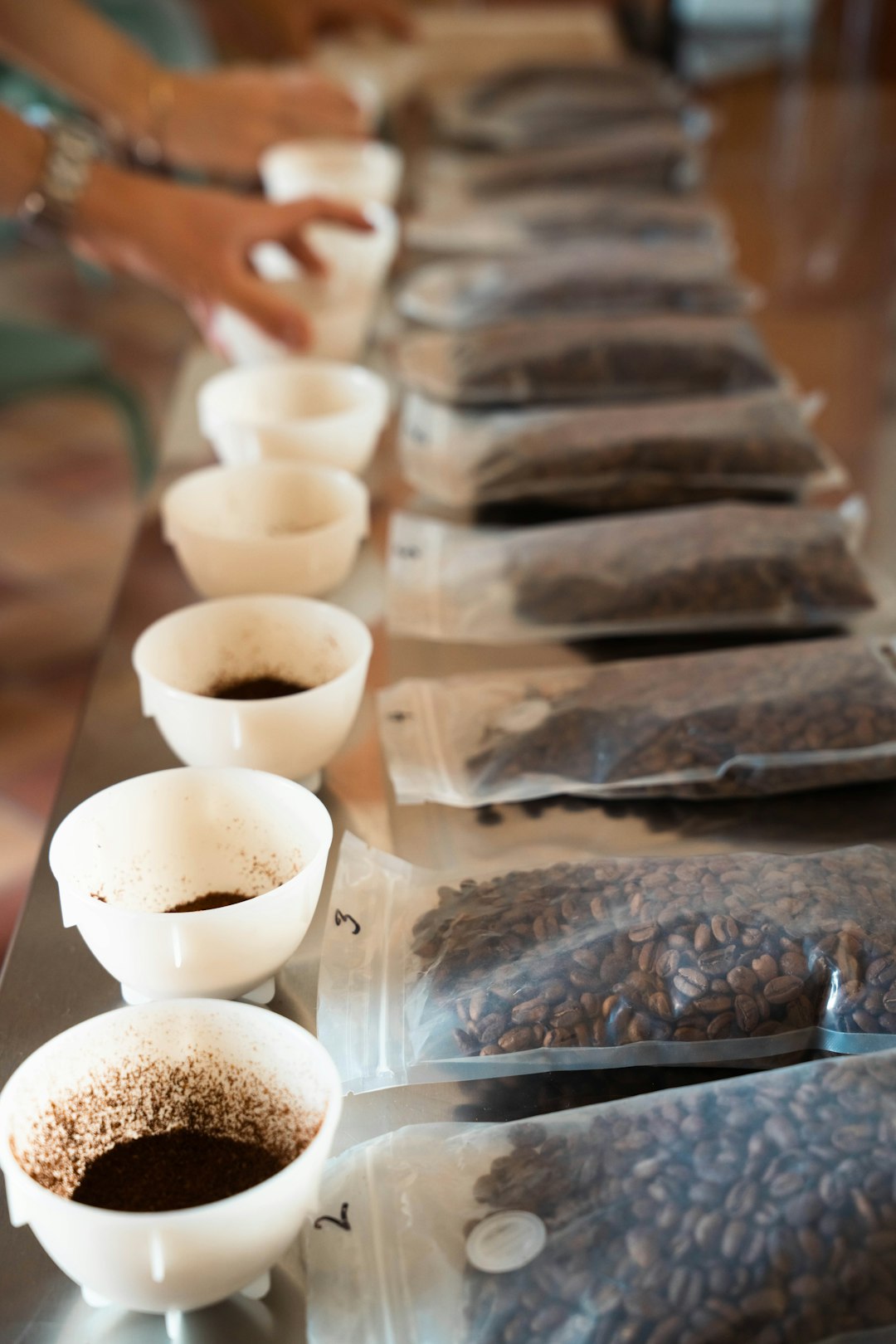
A US green coffee importer lists scales accurate to 0.1 g, a grinder with a fixed setting and a kettle of fresh water. Add identical bowls holding 207 to 266 ml and wide, flat spoons similar to a soup spoon. You also need rinse water, a timer, pen, paper and a spittoon. A Swiss roastery makes do at home with 200 ml cups or glasses and a tablespoon.
The SCA recipe is precisely defined. For 150 ml of water you use 8.25 g of whole beans, which are only ground afterwards. That is around 1:18. The grind is slightly coarser than for paper filters: 70 to 75 per cent of the grounds should pass through a US No. 20 mesh sieve. The water should be around 93°C, clean and odour-free, but neither distilled nor softened.
| SCA protocol | Swiss roastery for home use | |
|---|---|---|
| Coffee to water | 8.25 g to 150 ml | 12 g to 200 ml or 9 g to 150 ml |
| Grind size | slightly coarser than for paper filters | like polenta, 700 to 1,000 µm |
| Water temperature | around 93°C | 93 to 96°C |
| Grinding to pouring | no more than 15 minutes, covered no more than 30 | not stated |
| Breaking the crust | after 3 to 5 minutes | after 4 minutes |
| Tasting | from 71°C, around 8 to 10 minutes after pouring | 4 to 5 minutes after skimming |
| End | at 21°C | not stated |
| Cups per coffee | at least 5 | 5 recommended |
There is a small trap with the quantities. The importer advises weighing the water rather than going by the capacity of the bowl. The grounds displace water themselves: 11.5 g in a 200 ml glass take up around 15 ml. For the water itself, the SCA protocol gives 125 to 175 ppm of dissolved solids as ideal. How to assess your tap water is explained in Which water for coffee.
Step by step: smell, pour, break the crust, slurp
Allow an hour for your first cupping. Choose two to four coffees that are clearly different. You work on several bowls in parallel, always doing one step for all of them.
- Purge the grinder: Before each new coffee, grind a few grams of the same coffee and throw them away. That way, no remains of the previous sample end up in the bowl.
- Grind and smell: Weigh the beans for each bowl separately and grind them straight in. Within 15 minutes, smell the dry grounds; professionals call this the fragrance.
- Pour: Pour the water so that all the grounds get wet, and start the timer. A crust of coffee grounds forms on top.
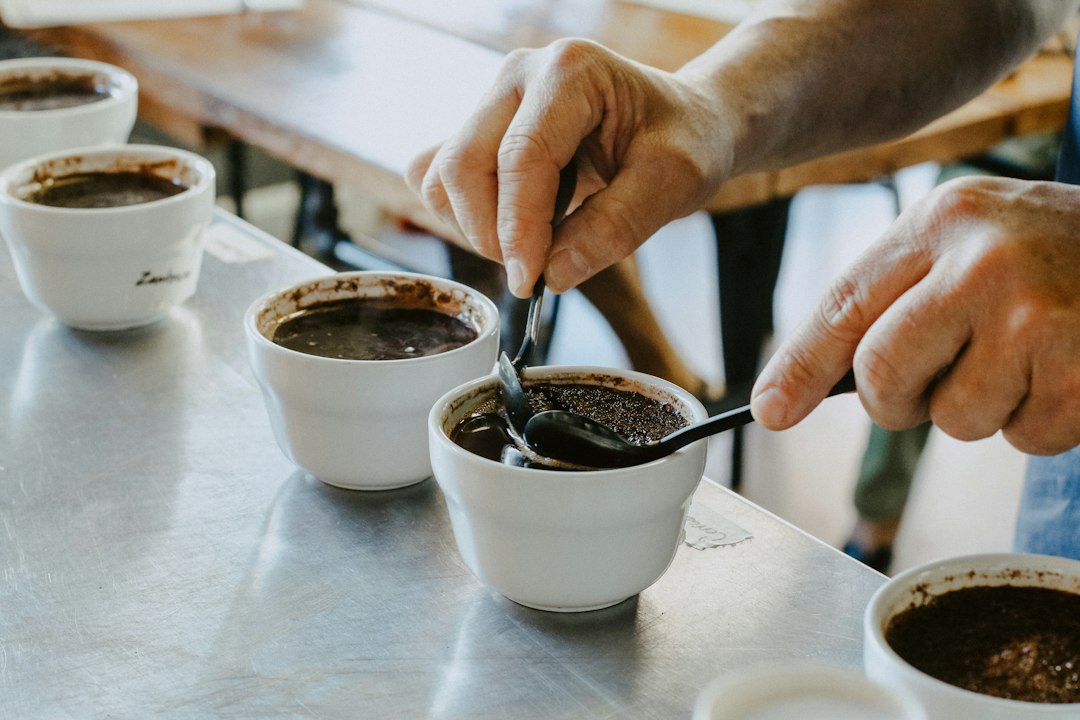
- Break the crust: After 3 to 5 minutes, push the crust aside three times with the spoon, your nose close above the bowl. This is when the strongest aroma rises. Rinse the spoon between bowls.
- Skim: Remove foam and floating particles with one or two spoons, without stirring up the grounds at the bottom.
- Slurp: Once the coffee has cooled to around 71°C, slurp a spoonful forcefully. That way it spreads across your whole palate.
- Repeat: Keep tasting as the coffee cools and note down your impressions. Stop at 21°C.
The importer explains slurping like this: the coffee cools, takes in oxygen and reaches all areas of the palate almost at once. Professionals then spit it out, because too much caffeine dulls the senses. At the end, pour the grounds through a fine sieve and not down the drain.
How to make your first cupping a success:
- Start with two coffees, for example a washed and a natural process coffee from the same region.
- Choose coffees with a similar roast level, otherwise you will mainly taste the roast.
- Weigh coffee and water separately for each bowl, accurate to 0.1 g.
- Set a timer and do not taste too early, as hot coffee masks a lot.
- For each bowl, first note what you taste and only then how much you like it.
The differences between the processes are described in Processing: washed, natural and honey. Why the roast level shifts the flavour so much is explained in Light, medium and dark roasts.
What to look for: fragrance, flavour, acidity, body, sweetness, aftertaste
The SCA protocol orders the attributes by temperature. At around 71°C, you assess flavour and aftertaste. Between 71 and 60°C come acidity, body and balance. Below 38°C, almost at room temperature, you look at sweetness, clean cups and whether all the bowls of a coffee taste the same.
| Attribute | When | What to look for |
|---|---|---|
| Fragrance | dry grounds | smell straight after grinding |
| Aroma | breaking the crust | smell of the wet grounds |
| Flavour and aftertaste | from 71°C | what you taste and how long it lasts |
| Acidity and body | 71 to 60°C | how pronounced the acidity is, how heavy the coffee feels in the mouth |
| Sweetness and uniformity | below 38°C | how sweet it seems, whether all bowls taste the same |
Putting it into words is the hard part. The Coffee Taster’s Flavor Wheel, a flavour wheel published by the SCA in 2016, helps here. It is based on the sensory lexicon of the research organisation World Coffee Research, with 110 terms. They range from pineapple and honey to defects such as cardboard and mould. Each term has an easily available reference, for cherry a sour cherry juice, for example.
According to the SCA, you read the wheel from the inside out. You start with the broad category, such as fruity, then move to citrus and then to orange. You can stop as soon as the description fits for you.
From the 100-point form to the Coffee Value Assessment
For decades, a cupping ended with points. In the old SCA protocol, ten attributes each received a score, with deductions for defects. A coffee scoring 80 out of 100 or more counted as specialty coffee. In November 2024, the SCA made its successor, the Coffee Value Assessment (CVA), the standard.
The CVA separates describing from judging. Peter Giuliano led the development team. He gave an interview to an online training platform for baristas. In essence, he said that tasters in the new system work as both descriptive and affective assessors. In the old form, Giuliano said, they jumped back and forth between the two, which he saw as a problem.
| old protocol (100 points) | Coffee Value Assessment | |
|---|---|---|
| Structure | one form, describing and judging mixed | separate forms, first descriptive, then affective |
| Scale | usually 6.00 to 9.75 per attribute in quarter points | intensity 0 to 15, liking 1 to 9 |
| Body | body | mouthfeel, meaning texture and weight in the mouth |
| Balance | separate attribute | part of the overall impression |
| Brewing method | cupping only | for the descriptive form also batch brew or French press |
| Also | deductions for defects | assessment of the green beans and details of origin and processing |
The Swiss roastery describes the forms in more detail. In the descriptive part, you record how intense fragrance, aroma, flavour, aftertaste, acidity and sweetness are. In the affective part, you state how well an attribute suits you. Points can be calculated from this digitally, but according to the roastery they no longer match the old total. For your kitchen cupping, this makes a good template.
Common mistakes when cupping at home
Most mistakes happen during preparation. The importer and the Swiss roastery name almost the same pitfalls.
| Mistake | Result | Better |
|---|---|---|
| tasted too hot | flavours stay hidden | wait until the coffee has cooled to around 71°C |
| grinder not purged | remains of the previous sample in the bowl | grind a few grams before each coffee |
| water measured by bowl size | ratio is wrong | measure the water on the scales |
| crust stirred vigorously | grounds get stirred up | push the crust gently aside |
| only one cup per coffee | defects in individual beans go unnoticed | several bowls per coffee |
| strong smells in the room | perception suffers | no perfume, no food with lots of salt, fat or spice beforehand |
Cupping with friends: taste blind, talk afterwards
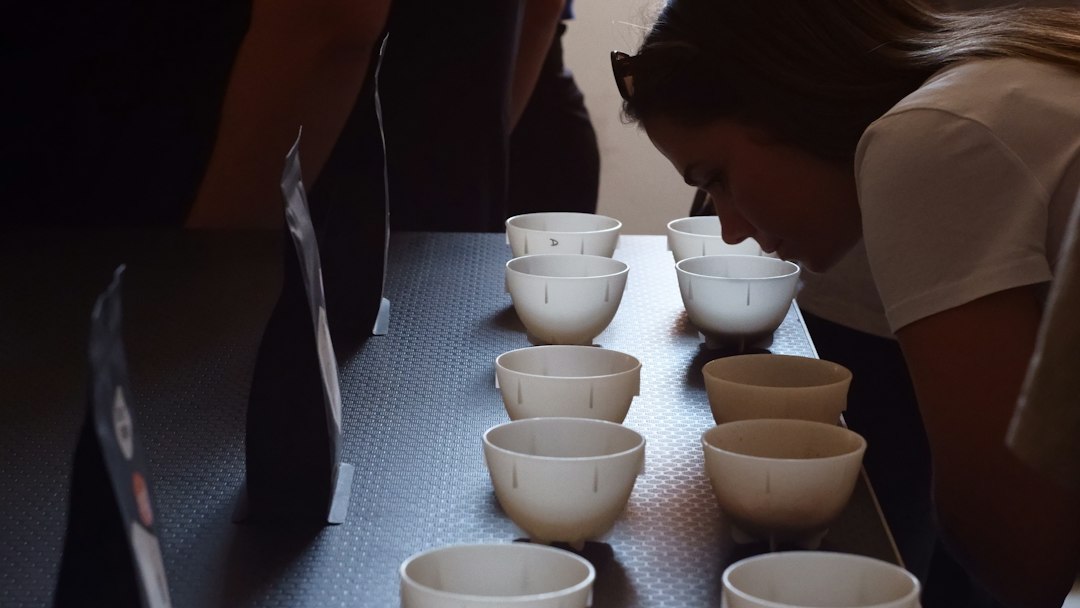
Cupping is most fun in a group. The importer advises giving the bowls random codes and writing down the key beforehand. That way, label and price do not influence your judgement. He also advises not talking about the coffees before tasting, otherwise one opinion steers the whole group.
The talking comes afterwards. In his experience, many people then taste again and change their notes. For six people, he allows at least 10 square feet of table space, just under one square metre (our conversion). Each sample gets its own rinse cup, and spoons never go in the spittoon.
Once you have found your favourite coffee, you can brew it very similarly every day, just with a plunger. How that works is explained in French press guide.
Last updated: 24 October 2026.
Sources
- Specialty Coffee Association: Protocols & Best Practices, Cupping Protocols, protocol © 2003, accessed 24 October 2026.
- Specialty Coffee Association: The SCA Officially Adopts CVA Descriptive and Affective Assessments as New Cupping Standards, November 2024.
- Daily Coffee News: SCA Officially Adopts New Cupping Forms and Standards, 5 November 2024.
- Jem Challender, Barista Hustle: Interview with Peter Giuliano on the Coffee Value Assessment (Beta), undated, accessed 24 October 2026.
- Nadja Schwarz, Kaffeemacher: „Evolved Q“ und das neue Coffee Value Assessment (in German), 5 June 2025.
- Nadja Schwarz, Kaffeemacher: Cupping: Wie du zu Hause Kaffee verkostest wie ein Profi (in German), 29 June 2023.
- Chris Kornman, Royal Coffee: How to Set Up and Run a Coffee Cupping: A Step-by-Step Guide, 27 June 2018.
- Nick Brown, Daily Coffee News: SCAA Unveils a Whole New Coffee Taster’s Flavor Wheel, 19 January 2016.
- Specialty Coffee Association: How to Use the Coffee Taster’s Flavor Wheel in Eight Steps, undated, accessed 24 October 2026.