For latte art you mainly need microfoam at 55 to 65°C and a milk jug of 350 or 600 millilitres. The rest is practice.Milk foam physics, steaming in two phases, heart, tulip and rosetta, and practising without wasting milk.
The first heart on your cappuccino is a small triumph. Before that you usually get blotches, lopsided splodges and patterns that look more like monsters. That is normal. Latte art is not about talent. It comes down to two things: milk with the right texture and a calm, repeatable hand movement.
You don’t need a professional machine. A steam wand with enough pressure, a suitable milk jug and fresh milk are enough. This guide takes you from steaming to the rosetta.
Our selection is editorial, there are no paid placements. Links marked * are affiliate links to Amazon Germany (amazon.de): if you buy through them, we receive a small commission at no extra cost to you. We have not tested the products ourselves; pros and cons are based on manufacturer information and retailer descriptions. Prices are guide prices from German shops as of October 2026, and prices and availability on Amazon may differ.
Why milk foams: protein, fat and the right temperature
Milk is a mixture of water, fat droplets and proteins. When you steam it, protein and fat wrap around the air bubbles as an elastic film and keep them stable. Whole milk contains around 3.3 grams of protein and 3.9 grams of fat per 100 millilitres. Experiments show that around 4 per cent protein produces the smallest bubbles, and small bubbles make more stable foam.
The goal is microfoam: glossy, with no visible bubbles, flowing like liquid paint. The target temperature is 55 to 65°C. At that point the milk tastes sweet and not yet cooked. Start with cold milk below 7°C, which gives you more time to texture it. You can read more about choosing milk in milk foam for cappuccino.
The right milk jug: size and spout make a difference
Two sizes have proved their worth. A 350-millilitre jug is enough for one cappuccino when filled to the base of the spout, which is around 120 to 140 millilitres. The 600-millilitre jug holds around 240 to 260 millilitres for two cups. The larger jug is easier for beginners because the milk has more room to swirl.
The spout matters too. A wide, round spout gives an even line width and makes the heart and rosetta easier. A narrow, pointed spout draws finer lines but needs more control. The cup should have thick walls and a round bottom, and hold 150 to 200 millilitres.
| Milk jug | Amount of milk | Enough for | Suitable for |
|---|---|---|---|
| 350 ml | around 120 to 140 ml | 1 cappuccino | more experienced baristas, small cups |
| 600 ml | around 240 to 260 ml | 2 cappuccinos | beginners, more room to swirl |
Steaming in two phases: stretch first, then roll
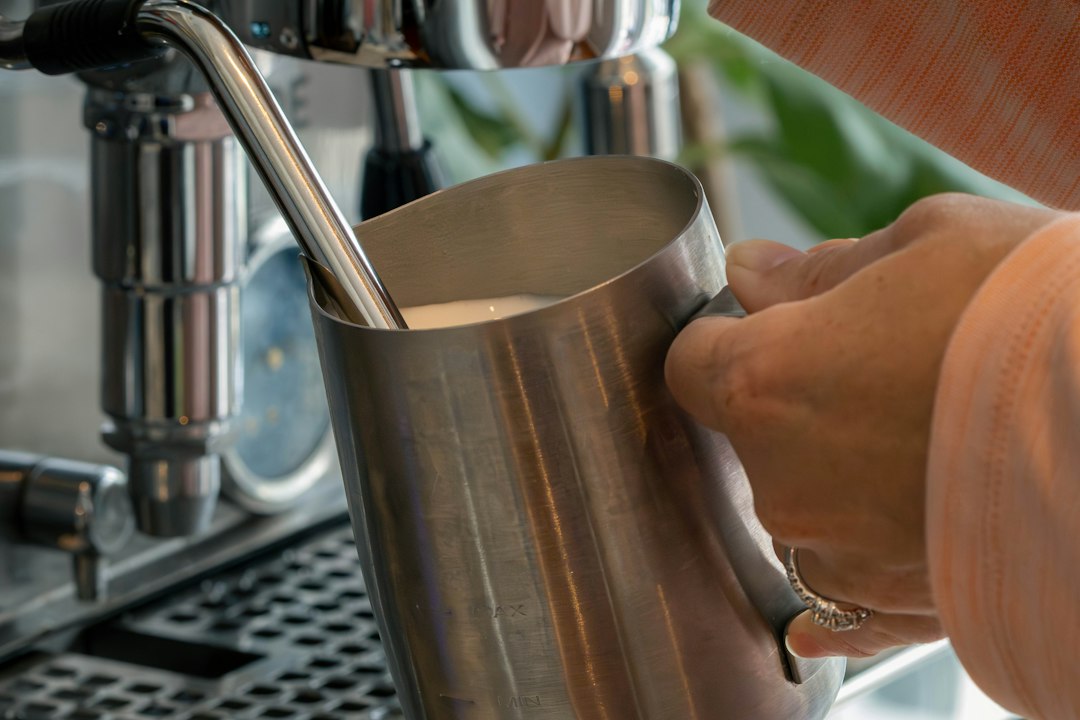
Make the espresso first. It can wait for a moment, but the milk can’t. Purge the steam wand briefly and dip the tip just below the surface of the milk.
Phase one is stretching. Position the tip so that you hear a quiet hissing, tearing sound. A loud, greedy hiss means too much air, so dip a little deeper. If you hear nothing at all, the tip is too deep and only heats the milk. Keep stretching until the milk is hand-warm, around 30 to 40°C.
Phase two is rolling. Lower the tip slightly until a whirlpool forms. It breaks large bubbles down into fine foam. Switch off when the jug gets too hot to hold. Then tap it once on the counter, swirl until the surface is glossy and wipe the wand straight away.
Heart, tulip, rosetta: the three basic patterns step by step
All three patterns start the same way. Hold the cup at a slight angle and pour a thin, steady stream into the centre from a height of around 4 to 5 centimetres. This way the foam dives under the crema and mixes in. When the cup is about half full, lower the jug close to the surface and tilt it more steeply. Now the white foam settles on the crema.
- Heart: A white dot forms in the centre. Let it grow, then lift the jug and draw the stream forward through the dot once.
- Tulip: Pour several dots one behind the other, starting in the lower third, with short pauses. Each new dot pushes the previous one forward. Finish by drawing through, as with the heart.
- Rosetta: Start as with the heart. As soon as the first dot appears, wiggle the jug from side to side in small, even movements and slowly pull it back. At the end, lift the jug and draw a straight line through the middle.
How to get to your first heart faster:
- Start with the 600 ml jug, cold whole milk and a wide spout.
- Stretch only until the milk is hand-warm, then let it roll and stop at 55 to 65°C.
- Pour within 30 seconds: high and thin first, then low and decisive.
- Learn the heart first, then the tulip, then the rosetta, one pattern a week.
- Practise without wasting milk, using water with a drop of washing-up liquid or old espresso.
Common mistakes and plant-based drinks that play along
The most common pitfalls are quickly listed. Too much milk in the jug spills over when you tilt it. Jerky pouring tears the pattern apart. If you lift too early, the white dot you build on is missing. Big, hectic movements and tense shoulders don’t help either. And foam separates from the liquid after around 30 seconds, so don’t wait too long.
Plant-based drinks are harder to foam. A 2025 review describes plant-based foam as coarse, quick to collapse and not very fluid. So choose barista versions of oat, soya or almond drinks, which are designed for steaming. Standard versions often give watery, coarse foam. According to its nutrition label, a widely available barista oat drink has 3.0 grams of fat and 1.0 gram of protein per 100 millilitres.
Practising without milk and a look at the world championship
Milk for a hundred attempts adds up. A tried and tested trick: water with a drop of washing-up liquid foams much like milk, so you can train your jug position and pouring movement. La Marzocco USA names washing-up liquid, water and old espresso as practice materials. Needless to say, you don’t drink it.
The World Latte Art Championship shows how far you can take it. In 2026 it took place from 10 to 12 April in San Diego, and Bala of Taiwan won. Jacky Chang of Malaysia and Zking of China took the next places. In the first round, competitors have to prepare six drinks in 11 minutes. These are two pairs of identical free-pour patterns and two identical designer drinks. The judges score appearance, creativity, contrast and how alike the pairs look. For more competition atmosphere, read World Barista Championship 2026.
Our recommendations
Milk jug · around €26 to €28
Rhinowares Stealth Milk Pitcher 600 ml
Pros: A proven latte art jug in exactly the 600 ml size we recommend for beginners. The milk has room to swirl in it.
Cons: The coating does not tolerate scouring pads.
Thermometer · around €12
Rhinowares Milk Thermometer, long (178 mm)
Pros: It helps you hit 55 to 65°C reliably while you practise, until you can feel the temperature with your hand.
Cons: It reacts slowly, so switch off a few degrees before the target.
Our selection is editorial, there are no paid placements. Links marked * are affiliate links to Amazon Germany (amazon.de): if you buy through them, we receive a small commission at no extra cost to you. We have not tested the products ourselves; pros and cons are based on manufacturer information and retailer descriptions. Prices are guide prices from German shops as of October 2026, and prices and availability on Amazon may differ.
You learn latte art through repetition: the same amount of milk, the same temperature, the same movement. After a few weeks the heart will be second nature, and the rosetta will follow. And if a pattern goes wrong, the cappuccino still tastes good. What else you need at the machine is covered in espresso accessories.
All prices are guide prices from German shops and may change. We have not tested the products ourselves.
Last updated: 24 October 2026.
Sources
- Spektrum der Wissenschaft, Verena Tang: Eine Prise Chemie: Der Traum vom perfekten Milchschaum (in German), 4 June 2026.
- Kaffeemacher, Benjamin Hohlmann: Latte Art zuhause (in German), 5 June 2025.
- Decent Espresso: For beginner and intermediate latte artists: new Decent milk jugs, 20 March 2025.
- La Marzocco USA: Practice Latte Art (without using milk!), 1 November 2022.
- World Coffee Championships: 2026 World Latte Art Champion, 12 April 2026.
- World Coffee Championships: World Latte Art Championship, accessed 23 October 2026.
- Sprudge, Zac Cadwalader: Bala of Taiwan is the 2026 World Latte Art Champion, 13 April 2026.
- Kaffeemacher: KM Barista Milchkännchen (in German), accessed 23 October 2026.
- Aromatico: Motta Thermometer, accessed 23 October 2026.
- Espresso Coffee Shop: Motta Latte-Art-Stift (in German), accessed 23 October 2026.
- Supermarktcheck: Haferdrink Barista Edition 1 Liter (in German), accessed 23 October 2026.
- Crema: Rhinowares, price accessed 23 October 2026.
- Crema: Rhino Coffee Gear, price accessed 23 October 2026.