Labels such as Fairtrade and organic guarantee audited rules, like a minimum price or farming without synthetic pesticides. Direct Trade is the roastery’s own promise, and nobody checks it.Prices and premiums, labels compared, Direct Trade without auditors, criticism and buying tips.
Many coffee bags carry several marks side by side. Fairtrade, the EU organic logo, Rainforest Alliance or a Direct Trade note all look similarly trustworthy. Yet they cover different things, sometimes the price, sometimes the farming.
The words ‘fair’ and ‘fair trade’ are not legally protected in Germany, as the Verbraucherzentrale Hamburg (Hamburg’s consumer advice centre) points out. Dollar prices are converted at the European Central Bank rate of 22 October 2026, where €1 equals 1.1205 US dollars.
Fairtrade: a minimum price as a safety net and a fixed premium
Fairtrade pays cooperatives a minimum price for export-ready green coffee. If the world market price falls below it, the buyer still pays the minimum. If the market is higher, the market price applies. On top comes a fixed premium in every case, and the cooperative’s members decide together how to use it.
On 1 December 2026, Fairtrade International raises its minimum prices. The premium and the organic differential stay the same.
| Fairtrade coffee | US dollars per pound | roughly per kg (our conversion) |
|---|---|---|
| minimum price washed Arabica until 30 November 2026 | 1.80 | €3.54 |
| minimum price washed Arabica from 1 December 2026 | 2.00 | €3.94 |
| minimum price Robusta, natural, from 1 December 2026 | 1.30 | €2.56 |
| Fairtrade premium, additional | 0.20 | €0.39 |
| organic differential, additional | 0.40 | €0.79 |
| for comparison: Arabica on the New York exchange, 23 October 2026 | around 3.07 | €6.05 |
Since March 2024, the world market price has not fallen below 2.00 US dollars per pound. So the minimum price is not kicking in at the moment. It protects against price crashes like the one in September 2001, when Arabica fell to 41 US cents per pound.
The roughly 300 g of green coffee behind 250 g of roasted coffee earn around 12 cents in premium. With the organic differential, it is around 35 cents (our calculation). In total, Fairtrade coffee cooperatives received just over €57 million in premiums in 2024.
The certification body FLOCERT audits the system. Fairtrade coffee must be physically traceable, so the bag really does contain certified coffee. Unlike cocoa or tea, coffee has no mass balance option.
Organic, Naturland Fair, Fair for Life and Rainforest Alliance: different priorities
The EU organic logo is mandatory for packaged organic food from the EU. It stands for farming without genetic engineering, synthetic pesticides and synthetic fertilisers. Next to the logo is the code of the inspection body, in the format DE-ÖKO-000.
The inspection bodies check every organic farm at least once a year, as required by the EU organic regulation (EU) 2018/848. The organic logo says nothing about prices or wages.
Naturland Fair builds on organic. Only farms that already work to Naturland’s organic guidelines can get the fair mark. Partners pay a price meant to cover production and living costs, plus a premium for goods from the Global South. The association does not name fixed amounts.
Fair for Life is certified by Ecocert, among others. Producers receive a guaranteed minimum price based on their production costs. Organic is not mandatory, but the standard supports conversion.
The Rainforest Alliance explicitly guarantees no minimum price. Buyers pay a premium, usually negotiated between buyer and producers. Since version 1.4 of the standard in October 2025, it must be paid in money. Producer groups must pay at least 40 per cent of it in cash to their members.
The Verbraucherzentrale Hamburg does not count the Rainforest Alliance among the fair trade marks. It considers some of the requirements too lax and the audits insufficient.
The labels compared: price, premium and audits
| Mark | Focus | Minimum price | Premium | Organic required | Audits |
|---|---|---|---|---|---|
| Fairtrade | price for smallholders | yes, from 1 December 2026 $2.00/lb (Arabica, washed) | $0.20/lb, organic +$0.40/lb | no | FLOCERT |
| EU organic logo | organic farming | no | no | yes | inspection bodies, at least yearly |
| Naturland Fair | organic and fair trade | fair price, no fixed figure | yes, amount open | yes | inspection bodies, yearly |
| Fair for Life | fair trade | yes, based on production costs | not quantified | no | e.g. Ecocert |
| Rainforest Alliance | environment and working conditions | no | negotiated, at least 40 % in cash to members | no | certification bodies |
| Direct Trade | quality and relationship | only the roastery’s promise | no rule | no | nobody |
Several marks on one bag complement each other. Organic covers the farming, Fairtrade the price. According to the Forum Fairer Handel (Germany’s fair trade network), around 80 per cent of fair trade coffee in Germany was also organic in 2025.
None of the marks replaces the duties under the EU Deforestation Regulation, which apply to large and medium-sized companies from 30 December 2026. Certified coffee also needs a due diligence statement with geodata, more on that in the EUDR for coffee and cocoa.
Direct Trade: a promise without auditors
Direct Trade means buying directly from a farm or cooperative, without anonymous middlemen. The term is not protected. There is no label, no auditor and no binding definition. Each roastery decides for itself what it means by it.
The term emerged in the early 2000s among roasteries in the US. A Chicago roastery pledged to pay at least 25 per cent above the Fairtrade minimum price. A Portland roastery only called a coffee Direct Trade after three years of working together.
In specialty coffee, purchase prices are often far above the Fairtrade minimum. A Basel roastery paid an average of 4.81 US dollars per pound at the port in 2025/26, weighted by volume. That is around €9.46 per kilo (our conversion). Its partnerships lasted 4.52 years on average.
Even so, this roastery avoids the term Direct Trade. By its own account, it only partly meets its own five test questions. A trader quoted there names directwashing as the most common abuse, meaning dressing up in someone else’s relationship work.
A high price for a top coffee also does not automatically mean more income, because better quality takes more work on the farm.
Market shares in Germany: Fairtrade at around 5 per cent
Around 456,000 tonnes of roasted coffee were sold in Germany in 2025, reports the Deutscher Kaffeeverband (German Coffee Association). Around 24,000 tonnes of it carried the Fairtrade label, a stable market share of 5 per cent. Because of high prices, sales of Fairtrade coffee rose to €1.04 billion.
The Forum Fairer Handel also counts goods without the Fairtrade label from fair trade importers. On that basis, fairly traded coffee reached 26,779 tonnes in 2025, just under 6 per cent of the roasted coffee market.
Worldwide, Fairtrade cooperatives produced around 525,500 tonnes of certified coffee in 2024. They sold only around 142,400 tonnes on Fairtrade terms, just over a quarter (our calculation). They sold the rest on normal terms, without a premium.
Criticism: what labels cost and where they hit limits
A label costs money, and the bill goes to the producers first. Under the fee schedule of the Fairtrade certifier FLOCERT of 4 March 2026, a smallholder organisation pays a one-off €612 to apply. On top come €1,629 to €3,113 in base fees per year, depending on the number of members. Each extra audit day costs €406 plus travel. For a large cooperative this is shared among many, but for a small group with little coffee it is a noticeable cost.
Certified coffee is also often not sold with the label at all. A 2024 review cites figures from Costa Rica. There, only 30 % of Fairtrade-eligible coffee sold as Fairtrade, 58 % for Rainforest Alliance and 3 % for organic. The costs of requirements and audits still arise. According to the review, larger farms get through certification more easily, because they can better afford labour and audits. Several labels at once brought mixed results, as extra work and costs partly ate up the higher price.
Organic adds a conversion period. For perennial crops such as coffee, the EU organic regulation requires three years of conversion before the first organic harvest. During this time, the farm already follows organic rules but may not yet sell its coffee as organic. Direct Trade saves the certification fees, but nobody outside checks what is promised.
The labels apply at the level of the cooperative or certificate holder. None of them shows what harvest workers earn. A 2017 review analysed 179 studies. It found that certification mostly improved prices and farm income, but higher household incomes did not follow automatically.
The authors found no positive effects on workers’ wages, but call the data thin. The minimum price has limits too. If the exchange stands at around 3.07 US dollars per pound, as in October 2026, a Fairtrade buyer pays the market price. The difference from conventional coffee then lies mainly in the premium.
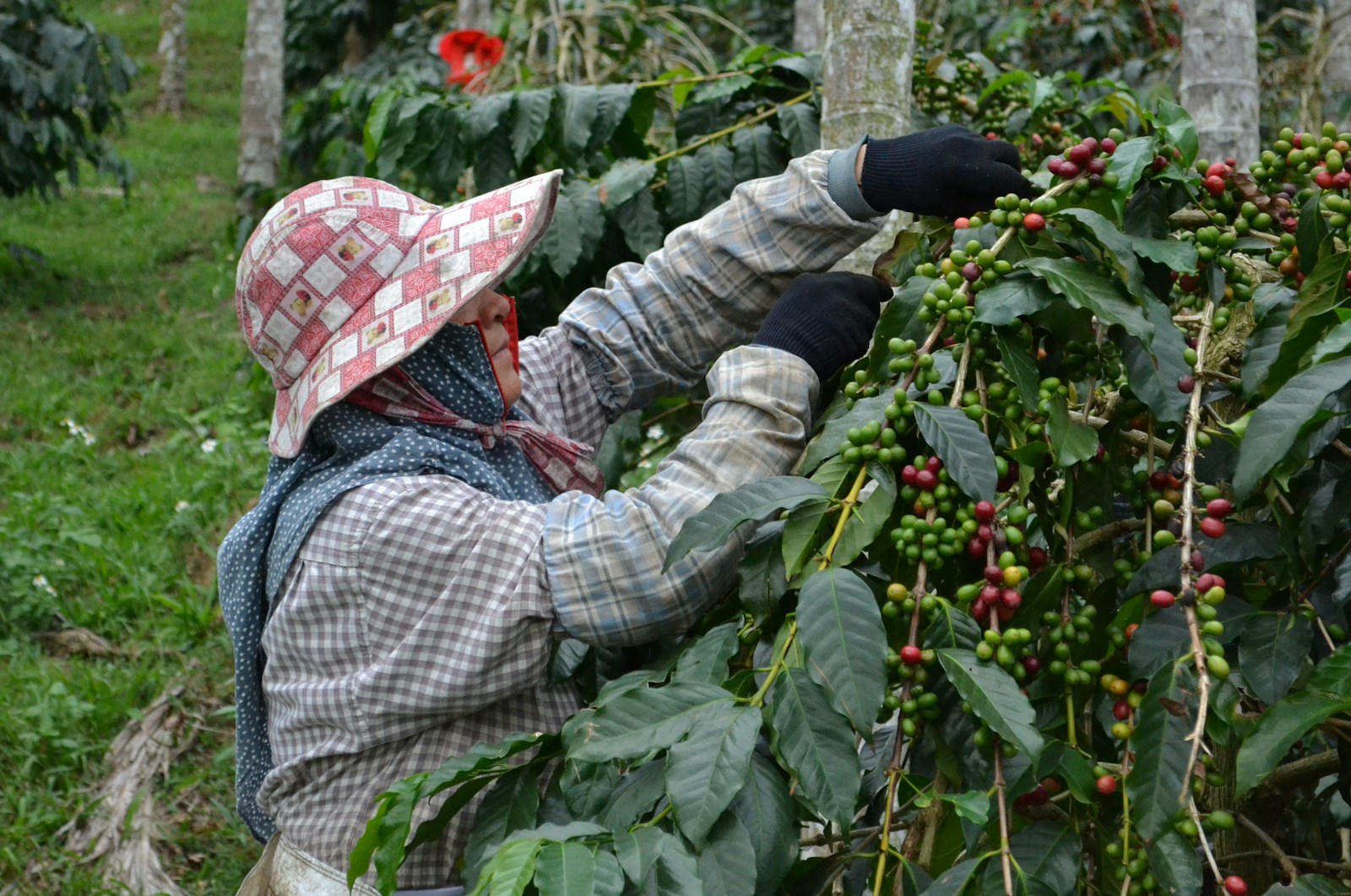
A label guarantees audited rules: a minimum price and a premium for Fairtrade coffee, the farming method for organic coffee. Direct Trade can mean more for the farm, but only published figures prove it. Why falling exchange prices still barely reach the shelf is explained in Green coffee is getting cheaper: why shelf prices barely move.
Last updated: 24 October 2026.
Sources
- Fairtrade Deutschland: Fairtrade aktualisiert Mindestpreise für Kaffee (in German), 30 July 2026.
- Fairtrade International: Monitoring Report, 17th edition (2024 data), 2026.
- Fairtrade Deutschland: Rückverfolgbarkeit in Fairtrade-Lieferketten (in German), undated, accessed 24 October 2026.
- Fairtrade Deutschland: Umsatz Fairtrade-Produkte knackt 3-Milliarden-Grenze (in German), 5 May 2026.
- Forum Fairer Handel: Entwicklungen im Fairen Handel 2025 (in German), July 2026.
- Deutscher Kaffeeverband: Deutscher Kaffeemarkt 2025 (in German), 2 April 2026.
- Trading Economics: Coffee: Price, Chart, Historical Data (Arabica 307.45 US cents/lb, 23 October 2026), accessed 24 October 2026.
- Verbraucherzentrale Hamburg: Fair Trade: Wann sind Schokolade, Kaffee, Zucker & Co. wirklich fair? (in German), as of 6 November 2024.
- Verbraucherzentrale: EU-Bio-Logo: Einheitliches Logo für verpackte Öko-Produkte (in German), 12 March 2026.
- Official Journal of the EU: Regulation (EU) 2018/848 on organic production, Art. 38 and Annex II Part I No. 1.7, 14 June 2018.
- Naturland: FAQ Naturland Fair, undated, accessed 24 October 2026.
- Ecocert: Fair for Life, undated, accessed 24 October 2026.
- Rainforest Alliance: Race to the Top: Our New Approach to Shared Responsibility, 28 February 2025, updated 3 March 2025.
- Philipp Schallberger, Kaffeemacher: Direct Trade Kaffee: Jeder darf es sagen, niemand muss es belegen (in German), 14 August 2026.
- FLOCERT: Gebührensystem Zertifizierung, Version 15 (in German), 4 March 2026.
- Jones, K.; Njeru, E. M.; Garnett, K.; Girkin, N., Sustainability 16(13), 5669: Assessing the Impact of Voluntary Certification Schemes on Future Sustainable Coffee Production, 2024.
- Kaffeemacher: Transparency Report 2025/26, June 2026, online 6 July 2026.
- 3ie, after Oya, C. et al., Campbell Systematic Review: Systematic review of agricultural certification schemes: findings and reactions, review 2017, accessed 24 October 2026.