A commercial espresso machine is built for continuous use. It holds the temperature at several group heads at once and delivers steam, even when the queue gets long.Boilers and group heads, pump and pressure profiling, plumbed-in water, grinders and prices.
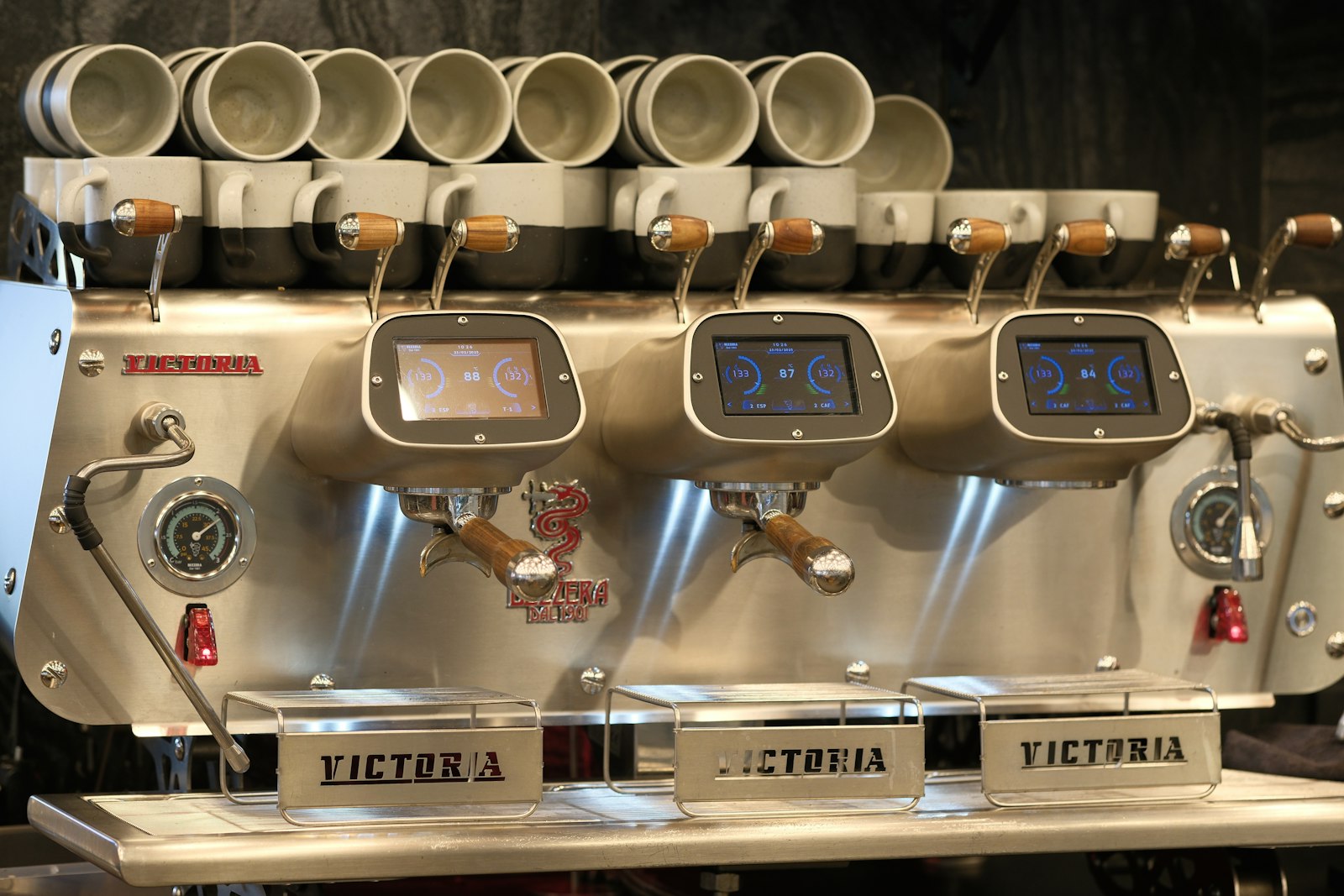
Stand at the counter of a busy café at lunchtime and watch for a while. Every group head has a portafilter locked in, and the steam wand hisses almost without a break. The moment one espresso has run through, the next portafilter clicks into place.
Your machine at home would soon run out of puff. According to a Swiss roastery, domestic machines are not designed for large rounds or catering use. Neither the steam pressure nor the brew temperature can cope with that load. A café machine is built for exactly this hour, and you can see it in the boiler, pump, water connection and grinder.
Boiler and group head: separate temperatures for espresso and steam
Espresso needs water at 90 to 96°C, while the boiler only produces steam at 120 to 130°C. How home machines solve these two tasks is shown in our comparison of single boiler, heat exchanger and dual boiler. Commercial café machines work on the dual boiler principle, with separate brew and steam boilers.
The principle comes from Florence. In 1970 a manufacturer there launched the first successful café machine with two separate boilers. It also introduced the so-called saturated group head. This is welded directly to the brew boiler, and the boiler’s hot water constantly flows around the group. As a result, the water hardly cools down on its way to the coffee.
The temperature is controlled electronically by PID. This control measures continuously and adjusts the heating power, to within a tenth of a degree in the brew boiler. A widely used two-group café model has two of these controllers, according to its data sheet. One is for the brew water, one for the steam.
Some machines go a step further and give each group head its own boiler. Each group can then be set to a different temperature. One group might run a light roast slightly hotter, the other the espresso for milk drinks. In quiet hours staff can switch off individual boilers and save electricity.
Steam and throughput: reserves for the lunchtime rush
For the queue at the counter, the steam boiler matters most. Every cappuccino draws steam from the same boiler. With a heat exchanger machine, steam power drops slightly after just two to six jugs of milk, according to the Swiss roastery. A café machine makes up for this with lots of water and lots of heating power.
The data sheet of the café model mentioned above shows how big the difference is. With every extra group, the boilers and heating grow.
| Version | Brew boiler | Steam boiler | Heating power | Supply (USA) | Weight |
|---|---|---|---|---|---|
| 2 groups | 3.4 l | 7 l | 4,600 W | 30 A | around 92 kg |
| 3 groups | 5 l | 11 l | 6,100 W | 50 A | around 109 kg |
| 4 groups | 6.8 l | 14.5 l | 8,000 W | 50 A | around 139 kg |
We converted the weights from pounds to kilograms. The supply ratings apply to the US grid at 208 to 240 volts. Domestic machines run on normal household power. Café machines of this size, by contrast, need their own heavily fused supply.
Pump and pressure profiling: how pressure reaches the coffee
Many home machines use a vibration pump. In multi-group café machines the rotary pump is standard, according to the Swiss roastery. It is more powerful, sturdier and quieter, but heavier. Between the pump and the group head sits a flow restrictor, a small tube with a bore of typically 0.8 mm.
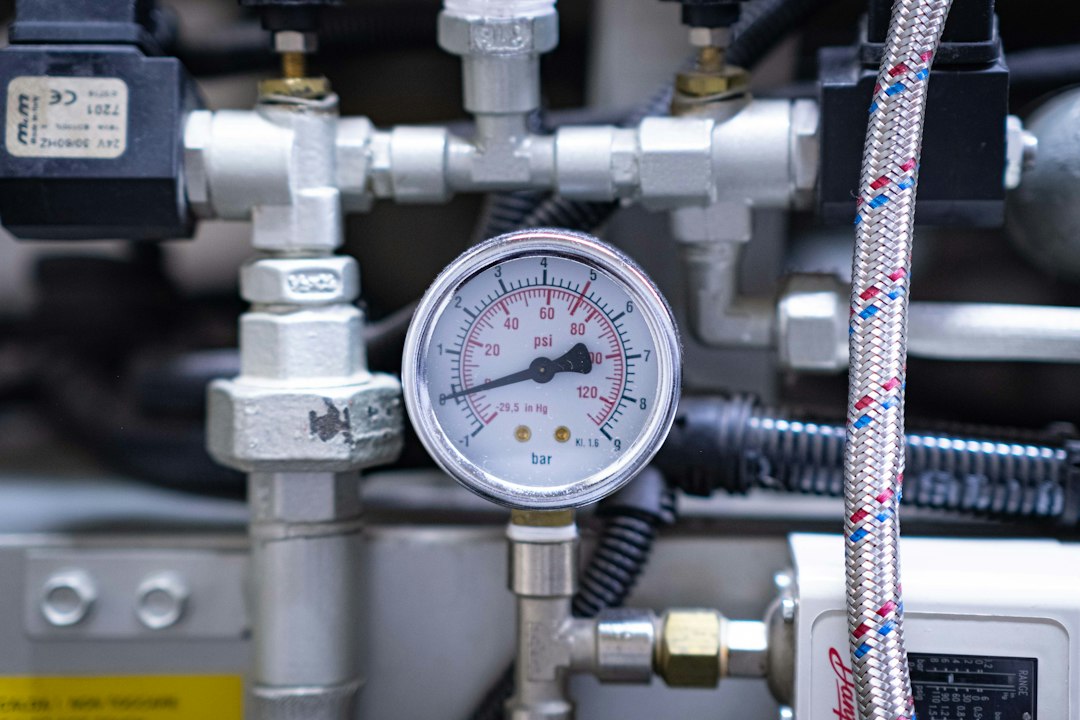
The pressure gauge on the machine measures pressure at the pump, not directly at the coffee. The restrictor limits how fast the water flows to the group. The learning platform Barista Hustle considers 200 to 280 ml of water in 30 seconds ideal.
With pressure profiling, the pressure changes during the shot. According to Barista Hustle, a common approach is a gentle pre-infusion at low pressure, then full pressure and a decline towards the end. At the end the coffee puck becomes more permeable, the water flows faster and channels more easily. Less pressure at the end can slow this down and extract more evenly.
Lever machines produce a similar curve without any electronics, because their spring relaxes during the shot. Modern café machines, by contrast, control the pressure with programs. Some run fixed stages, others adjust it continuously during the shot.
According to the Florentine manufacturer, separate pressure at each group requires one gear pump per group. On its top model the barista moves a small lever between 0 and 12 bar for this. Scales in the drip tray stop the shot at the set weight in the cup. A person still sets the grind size, just as when you dial in espresso at home.
Plumbed-in water and treatment: tap water decides how long the machine lasts
In a café the machine is usually plumbed into the water mains rather than fed from a tank. Many dual boilers for home use can also be plumbed in. But with plumbed-in water, everything in the tap water goes into the machine too.
A US retailer of café equipment summarised the key limits in 2026. Around 40 to 100 mg/l total hardness helps extraction, which is around 2.2 to 5.6 °dH (German degrees of hardness, our conversion). From about 120 mg/l the risk of scale rises, and the coffee quickly tastes chalky.
| Value according to the US retailer | Limit | Consequence |
|---|---|---|
| Total hardness | around 40 to 100 mg/l (2.2 to 5.6 °dH) | good extraction |
| Total hardness | above around 120 mg/l (6.7 °dH) | more scale, chalky taste |
| Total hardness | below around 40 mg/l | flat coffee, corrosion depending on the water |
| Chloride | above around 30 mg/l | pitting in the stainless steel boiler |
| Chloride, some manufacturers | no more than 15 mg/l | check the data sheet |
Scale builds up in the boiler, heating element and narrow pipes. For a heavily scaled machine with two or three groups, descaling costs several thousand dollars in labour alone, according to the retailer. Chloride is even more treacherous. It eats small holes into stainless steel, and a boiler damaged this way has to be replaced.
If there is a lot of chloride, the retailer recommends reverse osmosis without blending and then deliberately added minerals. The system must match the machine, as domestic units that are too small trigger fill errors. In the first one to two years of operation, the water should be tested again every quarter. The basics for home use are in which water is best for coffee.
Grinders in the café: fast, readjusted and warm
Next to the machine, cafés usually have grinders with a bean hopper. For high throughput in catering and offices, the Swiss roastery recommends exactly this type. It recommends single-dose grinders for most households, but they become too slow for many shots in a row. On the other hand, hopper grinders often retain 4 g or more of ground coffee in the burrs.
The grinder gets warmer with every shot. According to Barista Hustle, the heat comes mainly from breaking the beans and from friction in the burrs, hardly from the motor. If the temperature fluctuates, so do dose, shot time and flavour. Café grinders therefore cool with thermostat-controlled fans, or preheat the burrs during quiet periods.
The burrs wear with the amount ground. Depending on the model, manufacturers quote hundreds to thousands of kilograms. According to Barista Hustle, some professionals change them after just half that amount, because extraction slowly becomes less even.
In 2020 a team led by the chemist Christopher Hendon showed how much depends on grind size. It recommended that cafés grind slightly coarser and use less coffee. At a roastery with a café in Oregon, the dose fell from 20 to 15 g. According to the researchers, that saved 13 US cents per drink. Hendon called using less coffee the most repeatable step.
These figures apply to café use with its grinders and beans. At home, 18 g of ground coffee and 25 to 30 seconds remain a good starting point.
What a café machine costs and what of it reaches your kitchen
We did not find public list prices from German retailers for the top models. A US retailer charges 38,920 US dollars excluding tax for the Florentine manufacturer’s two-group top model. That is roughly €34,700 (our conversion). On top of that come grinders, water treatment, electrical connection and installation.
| Component | At home | In the café |
|---|---|---|
| Boiler | single boiler to dual boiler | dual boiler, sometimes one brew boiler per group |
| Temperature | PID to a tenth of a degree, not on every machine | PID for brew water and steam |
| Pump | vibration or rotary pump | rotary pump, sometimes a gear pump per group |
| Water | tank, plumbed in on some | plumbed in with water treatment |
| Power | household supply | own heavily fused supply |
| Grinder | often single dose | grinder with bean hopper |
Some of this is now available for the kitchen too. A dual boiler separates brew water and steam like the 1970 café machine, and PID control holds the temperature almost as precisely. What is mainly missing at home is the reserve for the lunchtime rush. You don’t need that for two cappuccinos in the morning anyway.
The lunchtime queue shows what a café machine is built for. Even so, the taste in the cup is decided by the beans, the grinder and the person behind them. How to spot a good café is explained in how to recognise a good specialty café.
Last updated: 24 October 2026.
Sources
- Benjamin Hohlmann, Kaffeemacher: Welche Espressomaschine passt zu mir? (in German), 23 June 2019.
- Benjamin Hohlmann, Kaffeemacher: Hand grinder, single dosing or grind-by-weight: How to find the right grinder, 14 March 2026.
- Barista Hustle: Æ 6.08 Pressure Profiling, undated, accessed 25 October 2026.
- Barista Hustle: Does Having Flow Restrictors in My Machine Mean I Get the Same Flow Rate Regardless of Where I Have My Pump Pressure Set to?, 31 January 2019.
- Barista Hustle: Æ 2.04 Warm Grinders and Temperature Stability, undated, accessed 25 October 2026.
- Barista Hustle: How Often to Replace Burrs on a Coffee Grinder?, undated, accessed 25 October 2026.
- Cameron, M. I.; Morisco, D.; Hofstetter, D.; Uman, E.; Wilkinson, J.; Kennedy, Z. C.; Fontenot, S. A.; Lee, W. T.; Hendon, C. H.; Foster, J. M., Matter 2(3): Systematically Improving Espresso: Insights from Mathematical Modeling and Experiment, January 2020.
- Jim Barlow, University of Oregon, via Futurity: To make better espresso, use less coffee, 23 January 2020.
- La Marzocco USA: Product Sheet Linea PB, November 2021.
- La Marzocco USA: Product Sheet Strada X, July 2026.
- La Marzocco New Zealand: The importance of dual boilers, 15 January 2026.
- Ben Blake, Scott Callender, La Marzocco USA: The Story Behind the GS3, 3 October 2014.
- Dani Howell, Espresso Parts: How Water Chemistry Affects Espresso Machines: Hardness, Chloride, Scale, and RO Water, 10 July 2026.
- Coffee Machine Depot: La Marzocco Strada X 2 Group, undated, accessed 25 October 2026.